

Huawei Launches Thailand AI Ecosystem Initiative, Bringing Agentic Infrastructure and CodeArts Agent to Advance Its ASEAN AI Hub Ambition
Huawei has joined forces with government agencies, businesses, telecommunications operators, local AI model developers, AI associations, and universities to launch the Thailand AI Ecosystem Initiative. The initiative aims to connect key players across the ecosystem and strengthen Thailand’s position as a leading AI hub in ASEAN.
The launch took place at the Huawei Thailand Digital & AI Summit 2026, held from July 23–24, 2026, at the Queen Sirikit National Convention Center under the theme “Advancing All Intelligence Thailand.” The event brought together more than 3,000 participants, including government representatives, telecom operators, enterprise customers, and industry partners. Discussions covered AI infrastructure, trustworthy AI, energy for data centers, and AI applications across multiple industries.

Thailand Builds Its AI Roadmap Around Infrastructure, Trust, and People
Chaichanok Chidchob, Minister of Digital Economy and Society, outlined Thailand’s AI development strategy through three key pillars: Infrastructure, Trust, and People.
One of the country’s priorities is to position Thailand as a real-world AI Governance Sandbox, where businesses, researchers, and regulators can collaborate to translate international AI principles into practical frameworks suited to the Thai context.
The government is also focusing on AI that supports the Thai language, understands local culture and context, and enables Thai people to participate beyond adoption. The goal is to allow local businesses, developers, and researchers to build, adapt, and lead with AI, while strengthening safeguards against online scams, deepfakes, and AI-enabled fraud.
Five Bottlenecks Holding Back Enterprise AI Adoption in Thailand
Austin Zheng, Deputy Managing Director of Huawei Thailand, said Thailand has strong potential to become a regional AI hub, but local organizations continue to face five major barriers:
- High computing costs and unclear returns on investment
- Fragmented or low-quality data
- General-purpose models that do not fully understand Thai language and industry contexts
- Concerns over regulation, privacy, and data control
- A lack of structured collaboration between business and technology teams
Huawei recommends that enterprises begin with high-value use cases that can generate measurable business outcomes. Organizations can then use industry-specific data to customize foundation models and develop internal talent capable of working across both business operations and AI technologies.
Huawei also announced a goal to train 40,000 AI developers in Thailand over the coming years, supporting the expansion of the local talent pool and helping organizations of different sizes access AI capabilities.
Thailand AI Ecosystem Initiative Connects Infrastructure, Industry, and Talent
The Thailand AI Ecosystem Initiative brings together Huawei, the Artificial Intelligence Association of Thailand, telecommunications operators, local AI model developers, businesses, and universities.
The initiative is designed to create an open and connected AI ecosystem that combines resources and expertise from multiple sectors. It seeks to balance innovation with trustworthy governance while developing local digital talent and accelerating AI adoption across industries.
The initiative also arrives as Thailand continues to attract investment in digital infrastructure, including data centers and AI-related projects. This growing foundation could support the country’s ambition to serve as a regional base for AI development and industrial deployment.
Huawei Cloud Brings Agentic Infrastructure to Thailand
Huawei Cloud also announced that Huawei Cloud Agentic Infrastructure is now available in Thailand, providing a foundation for enterprises to develop and deploy AI agents. The company also launched Huawei Cloud CodeArts Agent Open Beta Testing, giving Thai developers and organizations early access to its AI-powered software development platform.
Agentic Infrastructure is designed specifically for AI agents. It supports efficient token generation, unified scheduling of general-purpose and AI computing resources, long-term memory management, continuous learning, and secure autonomous operations.
Its four main components include:
- AICS, an AI cluster service designed to improve token-generation efficiency
- AMS, a PB-scale memory storage service supporting long-horizon tasks and continuous learning
- AgentSphere, a secure runtime environment for autonomous AI agents
- CCE VolcanoNext, which manages and schedules general-purpose and AI computing resources
CodeArts Agent Supports Project-Level Software Development
CodeArts Agent combines development tools, coding models, and autonomous software development capabilities.
The platform supports project-level code generation, code completion, research and development knowledge Q&A, and unit-test generation. It also uses Specification-Driven Development to help teams maintain software quality from the requirements stage through final delivery.
Another key feature is Agent Team Mode, which allows multiple AI agents to divide tasks and work simultaneously. This can reduce repetitive work and help development teams bring digital products and services to market faster.
Security and Data Control Remain Critical for Enterprise AI
Huawei Cloud said its enterprise AI security framework covers infrastructure, training data, model inference, and AI agent applications.
For organizations concerned about data sovereignty and privacy, Huawei Cloud provides dedicated security zones that allow customers to manage their own encryption keys. Its Data Capsule technology also restricts data use to authorized environments and automatically invalidates data if it is moved outside a designated security zone.
From AI Infrastructure to Real-World Value
The launch of the Thailand AI Ecosystem Initiative reflects how national AI development requires more than investment in cloud platforms or data centers. It also depends on connecting infrastructure, data, models, security, talent, and collaboration across government, businesses, and academic institutions.
Thailand’s next challenge is to turn these foundations into AI applications that solve real problems and create measurable value for public services, enterprises, and key industries.
Huawei, which has operated in Thailand for 27 years, said it will continue working with customers and partners to strengthen AI infrastructure, industrial applications, and talent development under its “In Thailand, For Thailand” commitment, supporting Thailand’s ambition to become a leading AI hub in ASEAN.
ลงทะเบียนเข้าสู่ระบบ เพื่ออ่านบทความฟรีไม่จำกัด

KBank Partners with Techsauce to Host "Empower The Future Economy"
KBank and Techsauce host "Empower The Future Economy," an affiliate event held during the IMF-World Bank Group Annual Meetings 2026, featuring Deputy PM Suphajee Suthumpun and lead...
 0
0

FROM LAB TO MARKET SPACE-F BATCH 7 KEY TAKEAWAYS AT TECHSAUCE GLOBAL SUMMIT 2026
สรุปไฮไลท์ SPACE-F ในงาน Techsauce Global Summit 2026 เผยทิศทาง FoodTech ไทย จาก Kitchen of the World สู่ศูนย์กลางนวัตกรรมอาหารระดับโลก...
0
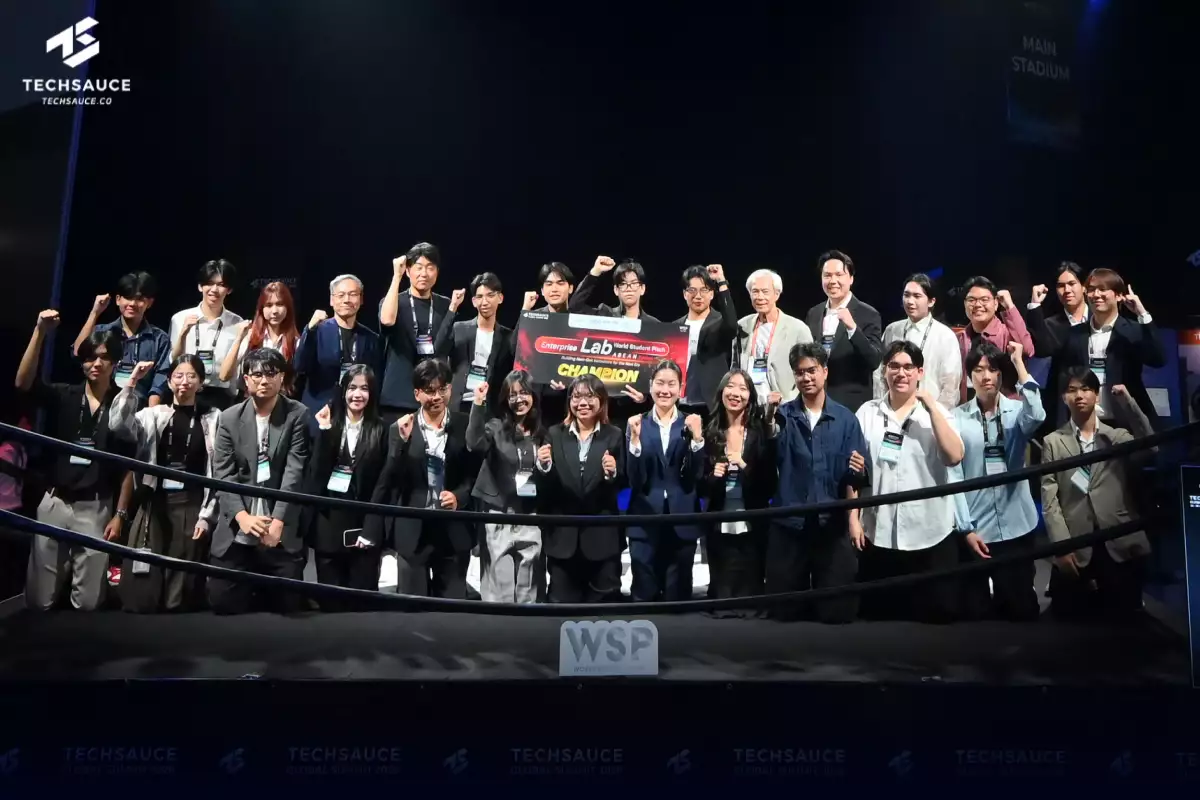
Student team Ctrl_A took the Grand Prize at Enterprise Lab: World Student Pitch ASEAN Edition 2026 with YARDS, an AI scrap steel grading system, beating eight other finalists at Te...
0
Wow, this is quite thrilling! I applaud Huawei's investment in Thailand's AI ecosystem; more projects like this are long overdue throughout ASEAN. The Agentic Infrastructure and CodeArts Agent seem like game changers for local developers sprunki and businesses. I'm especially curious about how these technologies will enable smaller businesses to innovate.