
One AI System for Many Companies: Lessons in Building an AI Strategy After a Merger
Mergers and acquisitions are one of the fastest ways for an organization to expand its capabilities in the AI era, bringing in technology, new markets, or valuable data and building competitive strength quickly. But the real challenge rarely arrives on the day the deal is announced. What comes with a deal is not just technology and a customer base. It is multiple systems doing the same work, databases that do not talk to each other, and, increasingly, separate AI systems built to different standards. The question leadership has to answer is how to bring all of it together into a single capability the whole group can share.
Before joining LlamaIndex, a leading AI company for document processing, I led the Machine Learning Engineering team at Onclusive, a global media intelligence company, where I managed a team of more than ten engineers and built the central AI system serving four merged companies. In this article, I share the AI strategy we used while the company was integrating several acquisitions: the decisions we had to make, the obstacles we ran into, and what I learned along the way.
The starting problem: when mergers leave you with several AI stacks
What set Onclusive's challenge apart was that the company did not start from scratch. It grew through a series of mergers. The difficulty lay in taking each company's application, each with its own database, backend, AI systems, and frontend, and combining them into one application that brought all of those capabilities together, known as the Unified Platform. Some of the companies ran on legacy software and relied heavily on manual work, while others ran on modern systems where AI handled nearly everything.
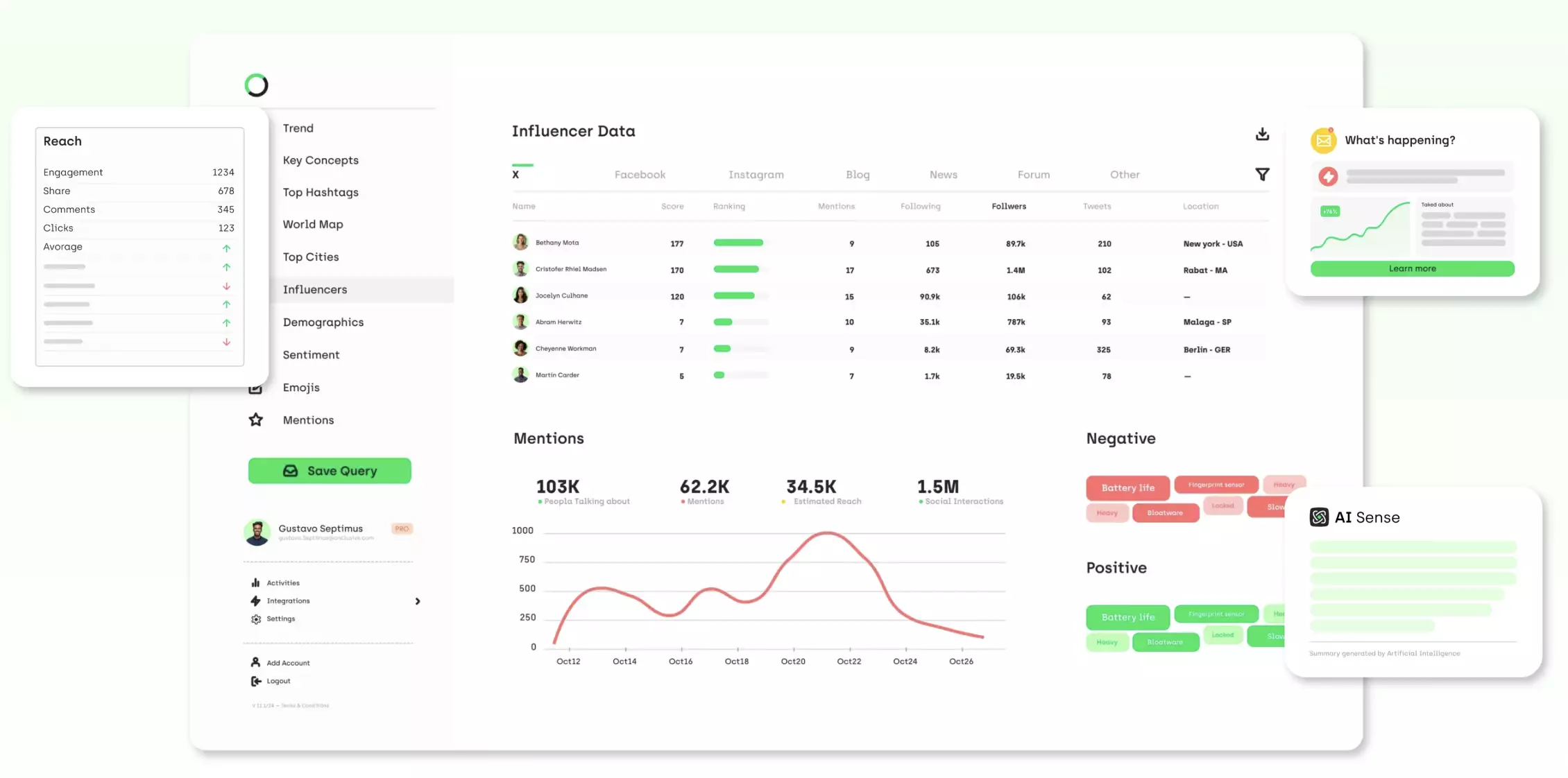
Onclusive's media intelligence platform brings mention analytics, sentiment, and insights into one view. (Image: Onclusive)
In the short term, letting each unit keep its own systems is the easiest path. But the hidden cost grows over time. The organization pays for development and computing several times over for the same kind of work. Customers using different products receive inconsistent data of uneven quality, because there is no single source of truth. And every improvement has to be repeated in every system.
The path I chose was to build a single central AI system shared by all four merged companies, which became the core logic behind the entire group's platform. This digital transformation brought challenges on several fronts. Internally, consolidating several companies' workflows into one system, with AI taking on more of the work, meant unavoidable restructuring and asking subsidiaries to change ways of working they were used to. Externally, the challenge was keeping existing systems running smoothly for customers while the integration was underway. Running two systems in parallel consumes significant engineering time and cost, but moving everything to the new system too quickly risks unexpected problems and inconsistent workflows and results for clients. Leadership and my team had to weigh these constraints and make decisions within them.
The AI strategy we used for this transformation rested on three pillars: the data foundation, elevating the product, and improving organizational efficiency.
Pillar one: start with a strong data foundation
In my experience, the first priority in any AI effort is the data foundation, because no matter how capable a model is, the quality of its answers depends on the quality of the data it retrieves. This is especially true in media intelligence, where data does not merely help the business see more clearly. The data is the business, and the product customers pay for.
For a media intelligence company, the raw material is a continuous, enormous flow of news and media content. Onclusive, for instance, serves more than 13,000 brands worldwide and monitors more than 3 million online sources, 70,000 print outlets, and 6,000 broadcast channels. Raw content alone cannot answer a customer's questions. It first has to go through a process called enrichment: extracting insight from text across every type of media, including online, television, radio, and print, to give the raw data meaning. AI sits at the heart of this work. The core tasks start with identifying which people or organizations a piece of content mentions, then linking each name to the right real-world entity in the database, since the same name can refer to different organizations depending on context, and finally analyzing whether each mention is positive or negative. Beyond understanding the text, content also has to be classified against industry-standard taxonomies, so that customers can efficiently find the articles relevant to their work and use them for insight analysis within Onclusive's application.
When applying AI to enrichment across a very large database, choosing the right tool matters enormously. I like to compare a large language model to a Swiss Army knife: it can do almost anything to a usable standard. Its strength is flexibility, since you do not need to know in advance what problem you will face. But once an organization knows exactly what the task is, how large the volume is, and that it must run every day, a tool built specifically for that task usually delivers equal or better quality at a fraction of the cost.
In a digital transformation that has to happen quickly, as Onclusive's did, the key is to focus AI development where it truly matters. If an open-source model or an existing service does the job well at an acceptable price, use it and spend the time on what genuinely sets the business apart. At the same time, be ready to build something specialized when the industry's problem is one nobody has solved yet.
The clearest example of the latter is classifying content against the media industry's international taxonomy standard, a hierarchy several levels deep with hundreds of subcategories. No off-the-shelf solution handled this directly, and calling a large language model for every item is not economical at the volume of content processed every day. The best approach was to build the model in-house, and to build it so it could be managed efficiently over the long term, not just created easily. The existing system used a separate model for each category. It worked, but it required a large number of machines running in parallel, and maintenance became more complex with every model added. I led the team to overhaul the system completely, redesigning it as a single model that understands the entire taxonomy hierarchy at once. The result: infrastructure costs for this workload fell by more than 90%, and maintenance was reduced to a single model.
Pillar two: use AI to elevate the product and the user experience
I divide the use of AI in products into two kinds that call for different thinking. The first is making the products each subsidiary already had more powerful and easier to use. The second is building new products in response to the shift in consumer behavior brought about by Generative AI.
In the first group, the AI systems at several subsidiaries were still running on older software. One example was a legacy sentiment analysis system that relied on keyword matching to decide whether an article was positive or negative for a brand. That approach could not understand context, and it could not handle articles that mixed positive and negative sentiment. I led the development of the new generation of AI that replaced these systems.
Beyond making the systems more capable, AI was also used to lower the barrier to entry. Some subsidiaries' products were complex enough that new users needed training before they could use them fully, which slowed customer growth. One example was the tool for finding journalists and publications relevant to a given PR campaign. The system I built accepts requests in natural language and searches the company's database directly. When a user asks for journalists who cover U.S. politics and are based in Spain, the system has to return both the names and the matching contact details, drawn from a database the company has built over many years, data that no public model has. What I learned is that the hard part is not getting the AI to understand the question, but making the answer trustworthy. If the list comes back wrong or incomplete, users will not keep using the feature in the long run, which is exactly why the first pillar, the data foundation, has to come first.
The second group is new capability created by the shift in consumer behavior that came with Generative AI. One of the most important questions in the PR industry is how a brand's reputation compares with its competitors'. A footwear company, for example, wants to know whether its brand comes up when a consumer asks for the best running shoes. As more people ask AI instead of a traditional search engine, brands need to know what AI says when someone asks about products in their category: which brands it mentions, and in what light.
I see this as a natural extension of media intelligence. The industry used to measure how a brand was covered in the media; now it also has to measure how a brand is portrayed by AI, the measurement side of what is often called generative engine optimization (GEO). I led the team that built a scoring system for brand reputation in AI-generated answers, allowing customers to benchmark their brand against competitors.
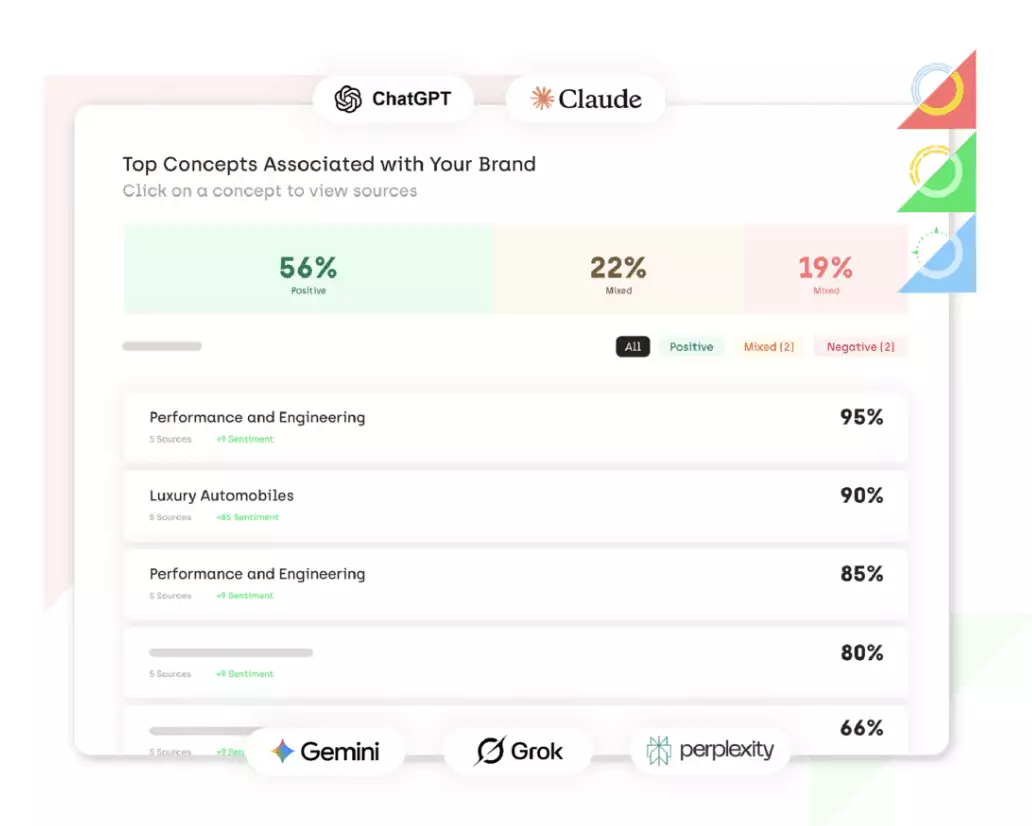
Onclusive's GEO Analytics shows which concepts AI platforms such as ChatGPT, Claude, Gemini, Grok, and Perplexity associate with a brand. (Image: Onclusive)
The difficulty is that a measurement system cannot see exactly what a consumer sees. Apps such as ChatGPT or Claude add a hidden system prompt, remember the user's history, and decide on their own when to search the web, none of which happens when the model is called through an API. On top of that, the same question does not always get the same answer. This gap cannot be eliminated, so I changed the goal from matching the numbers to matching the rankings, testing repeatedly through both channels until the results showed a monotonic relationship: if one brand is mentioned more often than another in the chatbot, the measurement system ranks them the same way, and that ranking is what customers actually base their decisions on.
Pillar three: use AI to improve efficiency inside the organization
Another key goal in integrating several acquisitions is making every system run as efficiently and cost-effectively as possible. I built the technology to automate a range of tasks that take a long time when done by hand.
The clearest example is automating the summarization of large volumes of documents, work that previously required people to read through many documents and condense them into insights directly relevant to each customer, in a form ready for immediate decisions. Language models handle this well, but their errors are hard to spot, because a fluent summary can contain information that is not in the source, a problem known as hallucination. My view is that when AI is not yet good enough at a job, the organization should invest more in that job, not less. Here, that meant building an agentic summarization system that checks its own output for hallucination and off-target length, and reruns the work when it fails those checks, so that the summaries customers receive are accurate and usable.
Another clear example is broadcast segmentation: extracting only the customer-relevant portion of a broadcast video. Each customer cares only about the segment that concerns them, which may be a few minutes within an hour-long program. This used to require a person to listen and cut manually, and multiplied across every program and every customer, the volume of work was enormous.
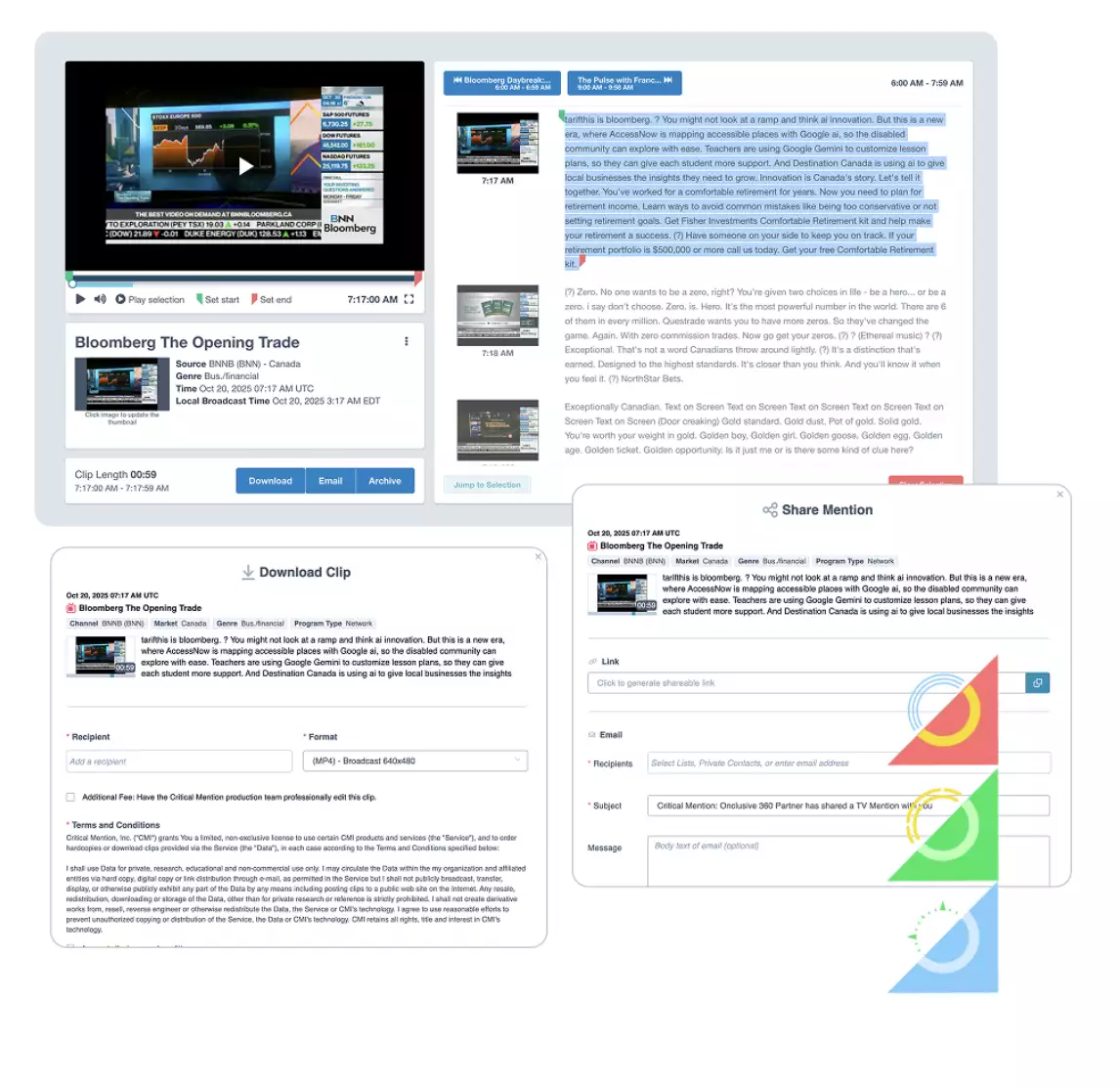
Onclusive's media monitoring interface for broadcast content, showing a customer-relevant clip alongside its transcript. (Image: Onclusive)
A complex AI task like this cannot be solved by asking a large language model once, in a single zero-shot prompt. The work has to be broken into a sequence of smaller steps connected as a graph, each doing one job and passing its state to the next: preparing the input and filtering keywords, selecting the relevant passage, finding the start and end times, checking whether the segment is an advertisement, and summarizing the content. Splitting the work this way means the right model can be chosen for each step, and when a result is wrong, the team can see exactly which step failed, unlike a single prompt, where failures are hard to diagnose. The result is a system that replaces manual clip-cutting at a scale people could not keep up with, while remaining verifiable step by step.
In the Generative AI era, these systems, along with many other applications across the organization, run on LLMs behind the scenes. Because an LLM can give different outputs for the same input, engineers cannot easily reproduce a failure after deployment. I therefore set up an observability system used by every LLM-based solution across the company, so the team can trace what each AI agent received, how it reached its decision, and what it returned. That visibility is the foundation for debugging and improving AI systems at an organizational scale.
The impact of bringing all the systems together went beyond engineering. It changed how the entire organization worked and led to the launch of a unified platform bringing the monitoring, measurement, and workflow capabilities of the merged companies into one place. The key lesson for me is that change on this scale must be carefully paced, because the organization has to keep existing systems running for customers while building the new one.
Lessons for organizations planning their AI strategy
I believe the experience of building AI in the middle of a merger applies directly to Thai organizations in general. The most important decision is made before the first line of code is written: agreeing on whether AI capability will be a central asset shared by every unit or left to each business unit to manage on its own. Any organization with multiple business units will face this question, and the right strategy depends on the nature of each task.
PTTEP, where I previously developed digital solutions, is a good example. Shared tools that every unit uses, such as an internal chatbot for answering questions about the organization, were developed by the central digital team and benefit the entire organization. Specialized work, such as digital solutions that require deep expertise in geology and subsurface engineering, or the evaluation of technical proposals in procurement, was developed by engineers within the business units who face those problems firsthand, with each team working closely with the central digital team. The result combined deep domain understanding from the people doing the work with shared technical standards across the organization, without duplicated development or databases siloed by department. I believe that freeing experienced staff from routine work to build solutions everyone can use over the long term is a worthwhile investment, even if the department's productivity dips at first.
The next lesson is about sequencing. Start with the data foundation before choosing a model. This matters whether or not an organization is doing AI at all. From what I have seen at many Thai organizations, the cost of not keeping data in structured form is higher than most people think. Employees waste time searching for and reworking the same information, mistakes creep in without version control, and building on the data with new technology or AI becomes difficult. Organizations that invest in centralizing and organizing their data, whether at the corporate or the department level, see an outsized return on that effort. Those that keep postponing the problem because it does not generate revenue in the short term will always pay for it in the long run.
The third lesson is to be clear about the type of work. I suggest looking at two variables: volume and frequency. For one-off or occasional tasks, an open-source model or a large general-purpose LLM is more cost-effective because no development investment is needed. But for well-defined tasks that must be repeated daily at high volume, investing in a specialized solution starts to pay off. That said, using AI to cut costs is not limited to reducing employees' working hours. In capital-intensive industries in particular, the main costs lie not in staff hours but in high-value investment and operational decisions. Using AI to reduce repetitive manual work therefore delivers far less than using AI and digital solutions to optimize those decisions, which can save money on a scale that reducing working hours cannot match.
About the author
Nutchapol Dendumrongsup is an applied AI research engineer currently at LlamaIndex, a leading AI company for document processing. He holds master's degrees from Stanford University. He previously led the Machine Learning Engineering team at Onclusive, a global media intelligence company, and developed AI solutions for the technical solutions function at PTTEP.
ลงทะเบียนเข้าสู่ระบบ เพื่ออ่านบทความฟรีไม่จำกัด

Techsauce visits the KOREA-GAME INNOVATION HUB at gamescom asia x Thailand Game Show 2026 to hear how 10 Korean game companies see Thailand and ASEAN, and what kind of local partne...
 0

Following the Enterprise Lab World Student Pitch ASEAN Edition at Techsauce Global Summit 2026, Techsauce spoke with Tirayu Songvetkasem, Chief Digital Officer of CP AXTRA. As an E...
0

When AI Chooses for Your Customer: Accenture Song on the New Rules of CX
Accenture Song's Tuomas Peltoniemi on how AI agents are taking over customer decisions, and the five lessons brands need before the buyer stops being human....
0