
The ASEAN Illusion: Why Cross-Border Expansion Demands Hyper-Local Execution
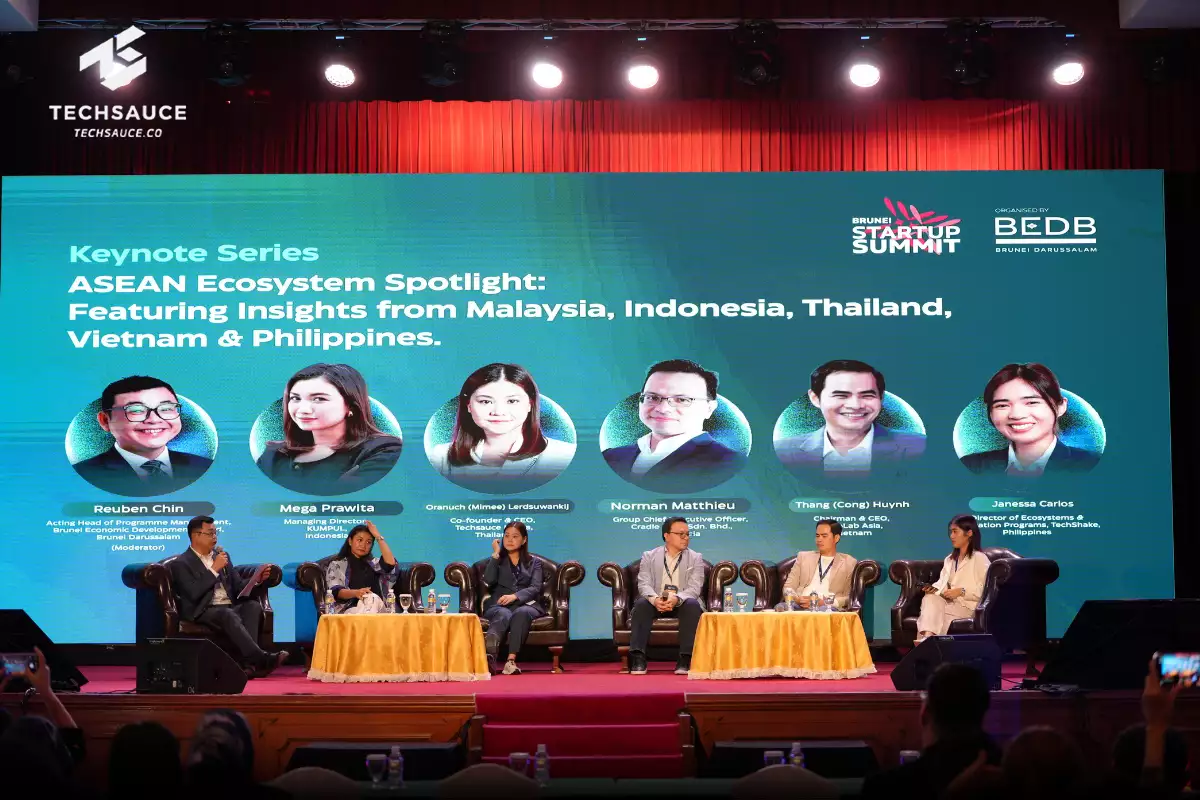
During the "Keynote Series: ASEAN Ecosystem Spotlight" panel at the Brunei Startup Summit 2026, a disagreement emerged regarding the absolute necessity of local partners for regional expansion. While the consensus among the ecosystem leaders from across Southeast Asia leaned heavily toward securing an on-the-ground counterpart, Norman Matthieu, Group CEO of Malaysia’s Cradle Fund, offered a different view.
"I think it's quite possible, actually," he stated, noting that highly independent founders can navigate new markets without a local partner. "I wouldn't say nothing's impossible. You can't do it on your own."
"Norman says I choose not to agree," replied panel moderator Reuben Chin, acting head of program management at the Brunei Economic Development Board (BEDB).
The exchange underscored the core challenge for tech founders looking to scale across Southeast Asia's 600 million consumers: a unified regional market is an illusion, and expansion demands hyper-local execution.
The Myth of the Universal Playbook
The most common trap founders fall into is assuming a successful domestic model can simply be exported. Thang (Cong) Huynh, Chairman and CEO of InnoLab Asia, pointed to an estimated 90% failure rate for foreign startups entering Vietnam.
"Let's say you have your website in Thai language and you translate that into Vietnamese, which means that you are already localized," Thang noted. "No. It's not about transforming your business thinking."
To illustrate the cost of ignoring local habits, he shared the story of a mentee who lost $1 million attempting to apply a Vietnamese-style, ad-heavy digital conversion strategy in Thailand. The founder stuck to an online-only model, misreading the local preference for physical retail validation. He eventually replaced his local partner and opened a physical store to gain traction.
In the Philippines, the challenges are different. Janessa Carlos of TechShake pointed out that while the country's high English proficiency and large digital user base appear attractive to foreign founders, incoming businesses often misjudge the macroeconomic reality.
"Please do not misjudge their purchasing power at the end of the day," Carlos warned, noting that a pricing model that works in Singapore or Malaysia will likely stall in Manila. She advises new entrants to follow a strict 90-day playbook: pause wider distribution and spend the first three months validating a single anchor customer.

Navigating the Cost of Entry
Beyond consumer psychology, the structural cost of entry varies wildly across the region. Mega Prawita, Managing Director of Kumpul, laid out the financial reality of entering Indonesia.
Foreign tech entities face a $600,000 USD minimum capitalization requirement. Acknowledging that establishing a formal presence is a daunting financial step, Prawita advises founders to delay full incorporation and instead run low-risk Proof of Concepts (PoCs). "Just don't settle first before you know the market," she advised. "Start with the small to medium enterprise first because it will help you validate the product."
Thailand takes a different regulatory approach. Techsauce Media Co-founder and CEO Oranuch Lerdsuwankij outlined how the Thai Board of Investment (BOI) is structured to attract "New S-Curve" industries like AgTech and BioTech. Startups that qualify can secure 100% foreign ownership and up to 13 years of tax exemptions.
However, Oranuch clarified that regulatory freedom does not equal commercial access. In Thailand’s B2B and B2G sectors, penetrating corporate hierarchies or government procurement channels requires deeply connected local partners who understand domestic deal-making.

The B2B2C Pivot and Strategic Niches
When the conversation shifted to consumer-facing platforms, the panel addressed the rising customer acquisition costs across mature markets like Thailand and Malaysia. For early-stage startups, paying for user acquisition through digital ad networks is increasingly unviable.
Oranuch proposed a structural workaround: pivoting to B2B2C models. By integrating into the existing infrastructure of retail networks, banks, or super-apps, startups can access established user bases. She pointed to LINE’s joint venture to create LINE MAN Wongnai as a primary example of leveraging an existing audience rather than building one from scratch.
For Bruneian founders looking to enter these larger ecosystems, Matthieu returned to the question of how smaller startups can compete, urging them to avoid derivative ideas.
"To put it simply, don't be a 'me too,'" he stressed. "Someone else has done it, do something else. How do you put yourself ahead of others?" He added that despite a cautious capital landscape, "if you have a great idea, a great solution, a great strategy, the money will come."
Thang challenged the local ecosystem to push harder. "From what I observed so far from Brunei, you guys live in a quiet comfort zone," he said, urging founders to step out of that space if they want to compete regionally.
Carlos acknowledged the sheer difficulty of penetrating new markets but reminded founders to lean on local ecosystem builders for honest reality checks. "We provide you with realistic feedback or evaluation if it's really working in our country," she said. If a product isn't landing, she noted, good local partners will redirect startups to other ASEAN markets rather than letting them fail.
Yet, Bruneian startups do have a structural advantage. Oranuch pointed to the Halal tech economy—a large demographic in Thailand that domestic developers often lack the cultural nuance to serve effectively. For Bruneian entrepreneurs, that specific expertise represents a highly defensible market position.
"This is a sweet spot," she told the founders in the room. "This is a lot of opportunity for you guys. Starting from doing the homework: What is your strength? Why will the local players in Thailand not do this?"
ลงทะเบียนเข้าสู่ระบบ เพื่ออ่านบทความฟรีไม่จำกัด

When AI Chooses for Your Customer: Accenture Song on the New Rules of CX
Accenture Song's Tuomas Peltoniemi on how AI agents are taking over customer decisions, and the five lessons brands need before the buyer stops being human....
 0
0

20 Years of Lessons from DeeMoney's CEO Technology Moves Information, but Trust Is What Moves Money
DeeMoney co-founder and CEO Aswin Phlaphongphanich unpacks the unspoken facts of global payments at Techsauce Global Summit 2026: there is no global transfer network, payment firms...
1

Some parts, I admit, were difficult challenges for me. But I have to thank the team for believing in me when others said it couldn’t be done....
0