
How Can a Thai Company Go Global? Lessons From Amity, an AI Company From Thailand That Raised $160 Million
Can an AI company built in Thailand reach global scale when its home market is far smaller than those of the technology leaders emerging from the United States and China?
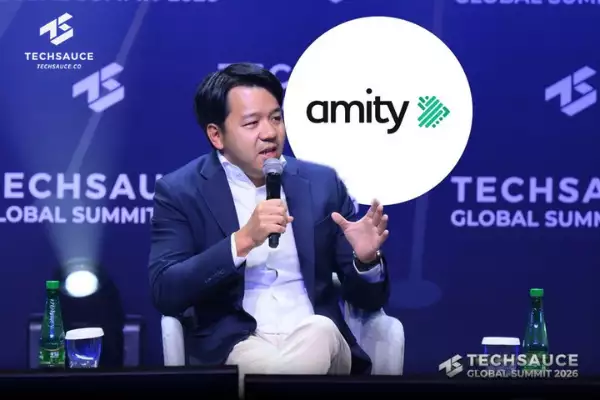
At Techsauce Global Summit 2026, Korawad Chearavanont, Founder and Executive Chairman of Amity, offered one answer. In the session "$160M Raised: Building a Global AI Player from Thailand," he described a strategy that links specialized models, acquisitions, financing and regional talent. The aim, he said, is not to recreate OpenAI. It is to build an AI company from Thailand that can compete globally.
That distinction matters. Amity's approach is less about winning a race for the largest general model and more about controlling the data, distribution and execution needed to solve narrower enterprise problems across multiple markets.
Smaller models can win when the data is specific
Korawad argued that the opportunity for companies in the region lies in Vertical AI, meaning models designed for a particular industry, geography or task. Frontier models learn largely from broadly available data. Yet much of the information that matters inside an industry never reaches the public internet. He used data flowing through Thai financial institutions as an example of information that general frontier models cannot access.
That gap creates room for a specialized model. Korawad contrasted frontier models with hundreds of billions or as many as one trillion parameters against vertical models with 7 billion to 10 billion parameters. In his account, a smaller model trained on relevant proprietary data can perform a specific task more effectively and at a lower computing cost.
The competitive advantage, then, does not have to come from building the biggest model. It can come from securing data that larger rivals lack and choosing problems where domain knowledge matters more than general capability.
A small home market demands global ambition
 "Our dream and our vision is to build a global AI player out of Thailand, at least a globally competitive player," Korawad said.
Korawad argued that Thailand or Southeast Asia alone would not provide a large enough market base for Amity to achieve the scale and research capacity required for global competition. He said more than 80% of Amity's profit already comes from outside Southeast Asia, with Europe serving as a major geographic focus.
 His strategic frame combines Europe and Southeast Asia into a market representing roughly $25 trillion to $26 trillion in GDP. Korawad compared that footprint with the size of China's economy. The figure was central to his argument that a company needs access to a sufficiently large market if it is to fund research and withstand competition from much larger American and Chinese players.
For a technology company originating in a smaller economy, international expansion is therefore more than an additional revenue stream. In Korawad's view, it is part of the infrastructure required to become globally competitive.
Buying distribution instead of rebuilding it country by country
Entering each new market organically means hiring a sales team, adapting the product and language, and establishing customer relationships from the ground up. Korawad said that after 14 years of trying to build a technology company from Thailand, he concluded that this path offered a low probability of success against larger incumbents.
Amity responded by adopting an acquisition-led rollup strategy in 2023. It buys software businesses that already possess customer distribution and proprietary data. Amity's teams then introduce AI into the core product, develop vertical models around the business and offer those capabilities to the acquired company's existing customers.
Each acquisition therefore serves two connected purposes. It provides an established route to market, and it opens access to data that can support specialized models. The acquired software business becomes a distribution channel, a source of domain data and an operating environment in which AI can be deployed against real customer needs.
Korawad noted that disciplined target selection is essential. Amity looks for companies whose products its AI teams can transform quickly and whose data, markets and customer base fit the broader strategy. The work begins after a deal closes, when the expected link between the acquisition and the AI platform has to be made operational.
Debt came before the $160 million in funding
 Acquisitions require capital before their results are proven. Korawad said Amity initially found it difficult to raise money for the AI rollup. The company used private credit and debt to finance its first acquisitions, then applied AI to those businesses and sought to demonstrate growth.
Once the model had evidence behind it, Amity raised $60 million in 2024. It repeated the process of acquiring software companies and transforming them with AI, leading to its latest $100 million round. Together, the two rounds brought the total to $160 million.
The sequence is as important as the headline number. Korawad and his team took early financing risk, produced operating evidence and only then secured larger pools of capital to accelerate the approach. In his telling, funding followed proof that the acquisition and transformation model could be repeated.
Global revenue, regional execution
Although most of Amity's profit comes from outside Southeast Asia, Korawad described talent in Thailand and the wider region as an execution advantage. The company's research labs are based in Bangkok and Singapore. He also referred to specialized talent in Europe and a team of a couple of hundred data scientists in India.
The regional teams matter because of how quickly they can work with acquired companies and turn conventional software into AI products. Korawad also argued that Thai teams work effectively across cultures, a capability that becomes operationally important when integrating companies in different countries.
This separates the market that generates revenue from the base that generates execution capacity. A Thai company does not need to earn most of its revenue at home for its Thai and Southeast Asian teams to remain central to its global competitiveness.
Ten years of groundwork before revenue took off
Korawad said on stage that it took Amity about ten years, from 2012 to 2022, to reach $10 million in revenue. He then described roughly two more years, from 2022 to 2024, to reach $100 million.
The year of that $100 million milestone appears in two versions. In Amity's Series D announcement of March 25, 2026, Korawad is quoted saying that annualized revenue, meaning revenue calculated at the current yearly rate, broke $100 million for the first time in 2025, expanding more than 10x since 2022. The session version puts the milestone in 2024, while the company's announcement puts it in 2025.
For 2026, he said Amity was closing in on $200 million in revenue. That matches the target in the announcement, which says the company is aiming to break $200 million in annualized revenue in 2026. The final result remains for the company to disclose. All revenue figures from the session are Korawad's own account.
His lesson was perseverance. Had the company stopped during its first decade, it would not have reached the point where the rollup strategy could begin compounding its earlier investment in research, teams and operating experience.
Korawad also pointed to open source and open weight models as an increasingly practical choice for enterprises. Open weight models make their trained parameters available for organizations to deploy and adapt. He argued that enterprises can train such models on their own data, retain more control over the AI stack and reduce token costs instead of relying exclusively on large frontier model providers.
This brings the discussion back to Vertical AI. Thai founders do not necessarily need the largest model if they can choose a valuable niche, secure differentiated data and build for a global market from the outset. Thai enterprises face a related decision: which data should remain under their control, which tasks warrant specialized models and what operating costs will accumulate over time?
Amity's story is therefore more useful as an operating thesis than as a fundraising milestone. For founders, global ambition has to be matched by a mechanism for acquiring distribution and data. For enterprises, greater ownership of the technology may begin with choosing the model that fits the work, rather than the model with the largest parameter count.
Source: "$160M Raised: Building a Global AI Player from Thailand," a session by Korawad Chearavanont, Founder and Executive Chairman of Amity, at Techsauce Global Summit 2026 on August 28, 2026.
ลงทะเบียนเข้าสู่ระบบ เพื่ออ่านบทความฟรีไม่จำกัด

Techsauce reports live from HUAWEI CONNECT 2026 as Huawei unveils Atlas 960E SuperPoD and Peerium Architecture. Discover how NPO optical interconnects enable one million processors...
 0
0
Beyond the Pilot: What It Takes to Move AI Agents into Production
At Techsauce Global Summit 2026, Ariya Banomyong of Wonderful Thailand outlined what separates AI pilots that scale from those that stall: cross-functional design, production-scale...
0

SCBX’s 3-Layer AI Roadmap: A Blueprint for Scaling AI in Big Companies
How to make AI not only a pitch project? Summarizing the AI-First strategy from SCBX and how to develop your company and measure that the ROI is happening....
0