
Small AI Can Create More and Better Jobs by Reaching Everyone
The most useful AI for emerging economies may not be the biggest model in the world. It may be a tool that helps a nurse assess a patient's rash through a 3G phone, or helps a farmer identify a crop disease from a photograph of a leaf.
That was the proposition behind "Small AI, More and Better Jobs," the opening session of the IMF-World Bank Annual Meetings in Bangkok. World Bank Group President Ajay Banga, Singapore President Tharman Shanmugaratnam and IMF Managing Director Kristalina Georgieva discussed AI less as a distant frontier and more as a practical tool for jobs, productivity and access to opportunity.
The backdrop is demographic. Over the next 15 years, 1.2 billion young people will turn 18. If they grow up with clean air, water, health care, education and skills, Banga said, that could be a major demographic dividend. But they will also need work: not only income, but the dignity and hope that come from contributing to society.
AI that works on a 3G phone

Banga contrasted two AI conversations. One focuses on large language models and the possibility that they displace workers. The other asks how AI can make daily work more productive for teachers, health workers and smallholder farmers.
The World Bank calls this second approach "Small AI." The aim is to create tools that are simple, locally relevant and accessible even on a phone connected to a 3G network. Edge AI, which processes information closer to where it is used, could be especially important where infrastructure is constrained.
He illustrated the idea with two scenarios. In a rural Indonesian clinic, a nurse could photograph a patient's skin rash and use a locally developed AI tool to help assess the condition. If it appears to be eczema, the nurse could provide treatment. If the case needs specialist care, the patient could be referred to a regional hospital with an appointment already arranged.
In India, Banga described a possible service for a farmer who cannot read. By photographing the underside of a leaf, she could use a mobile tool to identify a crop disease and receive advice on an appropriate pesticide. The wider platform could help farmers and cooperatives access fertiliser, seeds, crop insurance, credit and better prices.
The point is not to replace a nurse or farmer. It is to connect them to knowledge, services and markets that may otherwise be out of reach.
Five sectors where jobs can grow locally
The World Bank's Jobs Council has identified five sectors with potential to generate employment in developing economies without waiting for outsourced work from richer countries: infrastructure, smallholder agriculture, primary health care, tourism and value-added manufacturing.
Infrastructure includes not only roads, bridges, airports, electricity, water and digital networks, but also skills and education. Smallholder agriculture can become more productive when farmers have access to cooperatives and technology. Expanding community health services creates work for nurses, midwives and technicians while AI can connect them with specialists. Tourism can create employment across many connected businesses. Countries rich in minerals and metals can use value-added manufacturing to create better-quality domestic jobs rather than exporting only raw materials.
Banga argued that governments must build the conditions for investment, while private business is the principal creator of jobs. He estimated that the private sector creates 75% to 85% of jobs in countries. Public policy, infrastructure and risk-reduction tools determine whether private investment can reach the places that need it.
Growth no longer guarantees enough good jobs
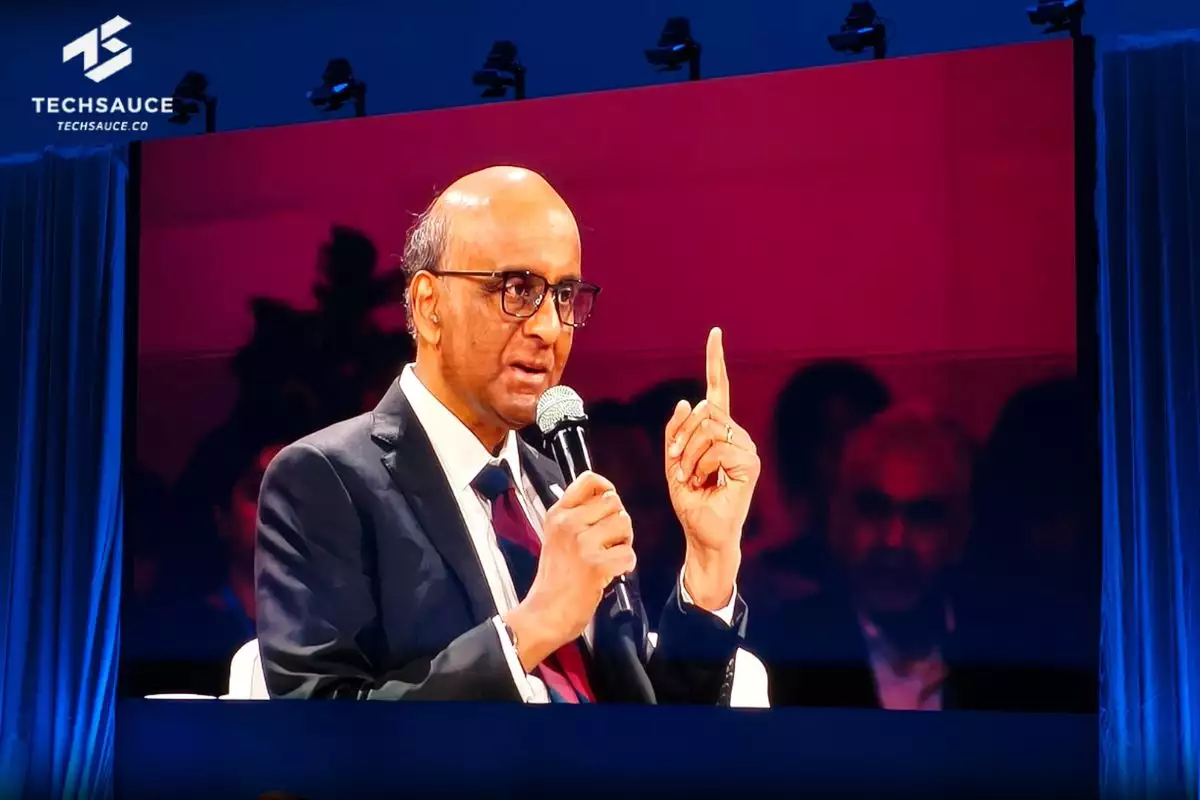
Tharman warned that economic growth and job creation are beginning to move in different directions. China, India and several developing Southeast Asian economies have continued to grow, but employment is not necessarily growing at the same pace. AI could widen that gap if governments and companies do not adapt.
He also warned of a K-shaped labour market in which some people and firms gain while others are left behind. One especially urgent concern is the shrinking first rung of the career ladder. If graduates cannot secure a first job, they lose the experience and confidence that make later opportunities possible, while the next cohort of graduates enters the same competition.
His response is to make work-based learning more central to education. Universities need stronger links to internships, real work and dual-learning models. There is no single template because some occupations need deep specialisation while others require people who can combine disciplines and work effectively with AI.
From AI investment to AI adoption
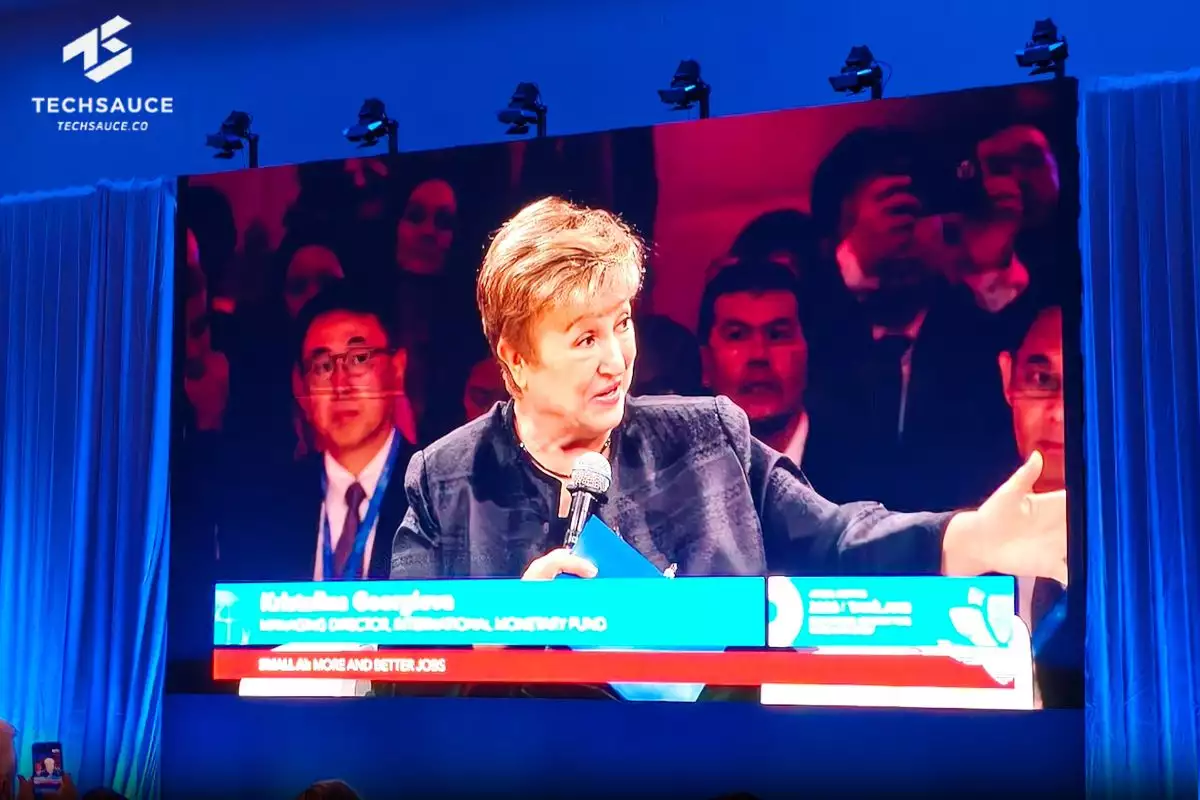
Georgieva described the first economic wave of AI as massive investment in models and data centres. That spending has already supported demand and growth in countries that build AI and in Asian economies that supply the infrastructure. The next wave, she said, is broad adoption.
For developing economies, adoption depends on electricity, digital infrastructure, people's readiness to use technology and public safeguards. The IMF estimates that AI could add around 0.5 to 1 percentage point to growth in advanced Asian economies and 0.2 to 0.8 points in emerging Asian economies. In ageing societies, a one-point gain could be large enough to offset some of the economic drag from demographic change.
The opportunity comes with labour-market risk. The IMF estimates that roughly 40% of jobs globally could be affected by AI over time, including through augmentation, reduced importance of some tasks or replacement. The share is estimated at around 60% in advanced economies and 23% in low-income countries. A lower figure does not mean low-income countries are safe. It can also mean AI has not yet reached them widely.
Georgieva's policy priorities are to track labour-market change, reform education for lifelong learning and reconsider fiscal systems if economies rely less on human labour and more on capital. No one can say exactly what work will look like in five years. Governments can still collect evidence, learn from deployment and adapt.
The leaders' shared aim was not AI for its own sake. It was technology that expands capability: helping people do useful work, giving young people a route into employment and ensuring that the next wave of productivity is not limited to the countries and companies that can afford the biggest models.
ลงทะเบียนเข้าสู่ระบบ เพื่ออ่านบทความฟรีไม่จำกัด


At SICW 2026, Singapore announced a Cybersecurity Professional Accreditation Framework, with a pilot set for 2027. Speakers urged organizations to automate the task, not the learni...
 0
0

No one sees the whole cyber threat picture. At SICW 2026, Singapore launched its Cybersecurity Strategy 2026 and NC3 to defend at national scale with AI, raising a key question: wh...
0

At SICW 2026, Estonia’s digital minister explained how a small nation built its digital state on trust, and how it is adapting now that AI agents can lead cyberattacks on their own...
0