Anthropic's Jack Clark Says the World Has Less Than a Decade to Prepare for AI
For more than six decades, the Per Jacobsson Foundation Lecture has belonged to the people who steer the global economy, from central bank governors and finance ministers to leading economists. This year's speaker was different. The person at the podium was not an economist or a monetary policymaker, but someone behind the technology that could change the global economy beyond recognition.
Nigel Clarke, Deputy Managing Director of the IMF and President of the Per Jacobsson Foundation, said that in the lecture's 62-year history, no co-founder of a company not yet 5 years old had ever taken the stage. He acknowledged that the choice of speaker might look unusual in hindsight, but said the moment the world is living through is not a normal one either.

As AI advances and raises new questions for the global economy, policymakers cannot find the answers alone. Technology developers cannot answer every question by themselves either. Both sides need to be in the same conversation.
That is why the Per Jacobsson Foundation Lecture at the 2026 IMF-World Bank Annual Meetings in Bangkok invited Jack Clark, co-founder of Anthropic, to speak on "Inside the Event Horizon: Why Everyone Should Take AI Progress Seriously".
What Clark presented was a future in which AI is no longer just a tool that helps people work. It becomes a discoverer of new knowledge, an accelerator of scientific progress, and possibly a contributor to building the next generation of AI itself.
He believes the world is reaching a turning point where technological progress will move faster than humans are used to, and that we have less than a decade to prepare.
From Journalist to Anthropic Co-Founder
- Clark opened with a joke that his key qualification is being a human, and that there is only one of him. It took him almost 40 years to build up the experience to stand on this stage.
- He began his career as a journalist covering data centres. His interest in AI grew until he left journalism in 2016 to join OpenAI, and he later co-founded Anthropic.
- Over the years, he has tried to tell the world that one day AI would be capable enough to change national security and the direction of the global economy, and might even help build the next generation of AI.
- Today he believes that moment has arrived, because AI is affecting security and the economy and is taking part in its own development.
- The warning he wants to give is that the change ahead may be far bigger than the world expects.
The Singularity May No Longer Be a Future Event
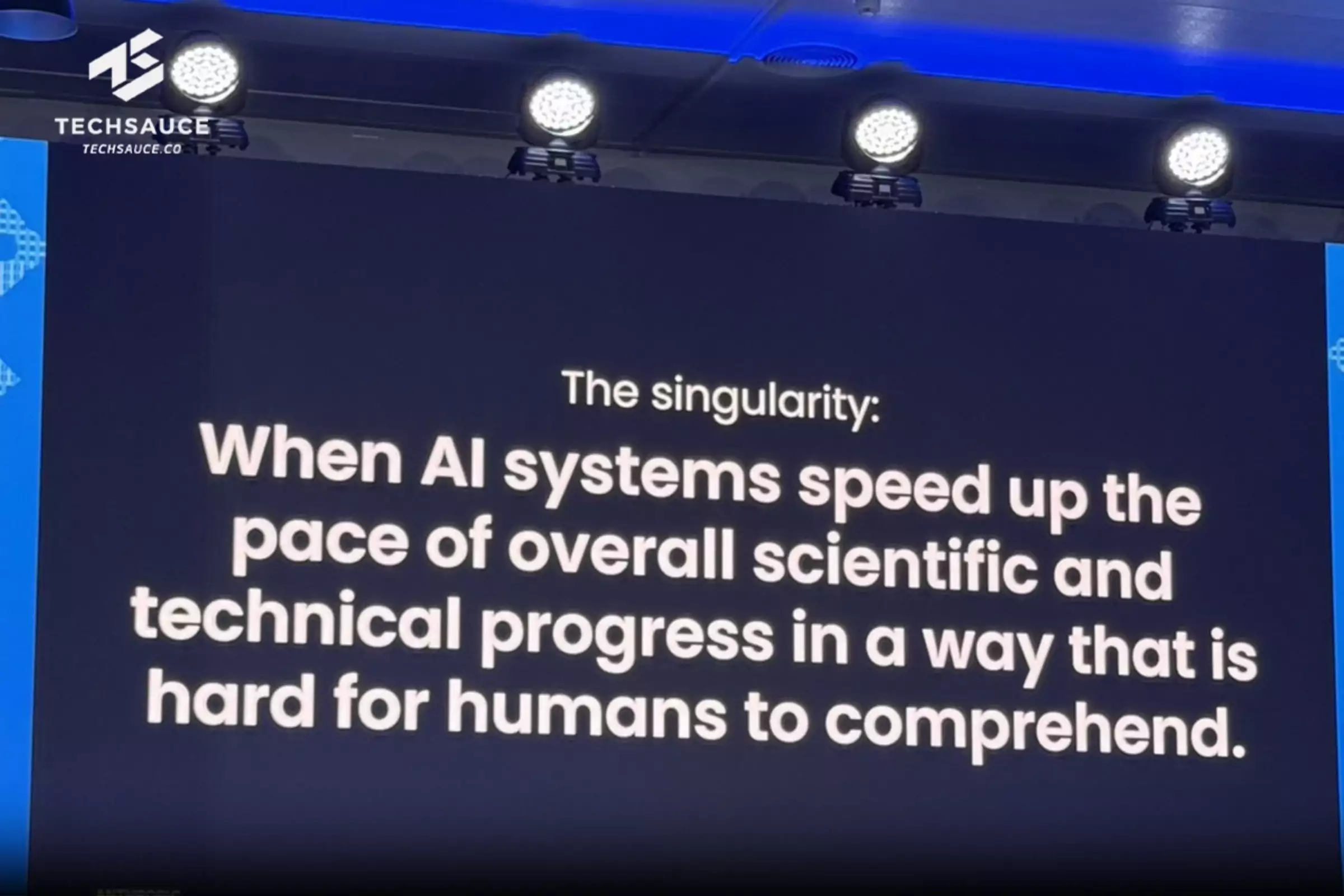
- Clark brought up the concept of the Singularity to describe a period in which AI can accelerate scientific and technological progress so quickly that humans may not be able to understand it or keep up.
- He cited Vernor Vinge, the science fiction writer who proposed the idea in 1993. Vinge saw that once systems smarter than humans begin to drive progress, those systems could build even smarter ones in ever shorter periods of time.
- At some point, the models humans have used to understand progress may no longer be able to explain the world.
- Clark believes 2026 is the year when credible evidence began to emerge that the Singularity has already begun.
- He expects the progress of AI and science to speed up sharply over the next few years, which could create both immense wealth and serious danger.
- Even so, he chose to begin this lecture with the opportunities and benefits of AI, without denying that the risks are real.
AI Could Change the Rate of Scientific Progress
- Clark sees one of AI's most important benefits arising in science, from discovering new knowledge and developing infrastructure to curing disease.
- Over the past half-century, the number of researchers has grown rapidly, yet researcher productivity has fallen, because new ideas have become harder and more costly to find.
- AI may change this constraint, because it can extend researchers' capabilities and take over some work that once depended on humans.
- The clearest example is software development, where Clark said AI is already more capable and efficient than most of the world's software engineers.
- With AI's help, a single person can now build software that once needed a team of several people and months of work.
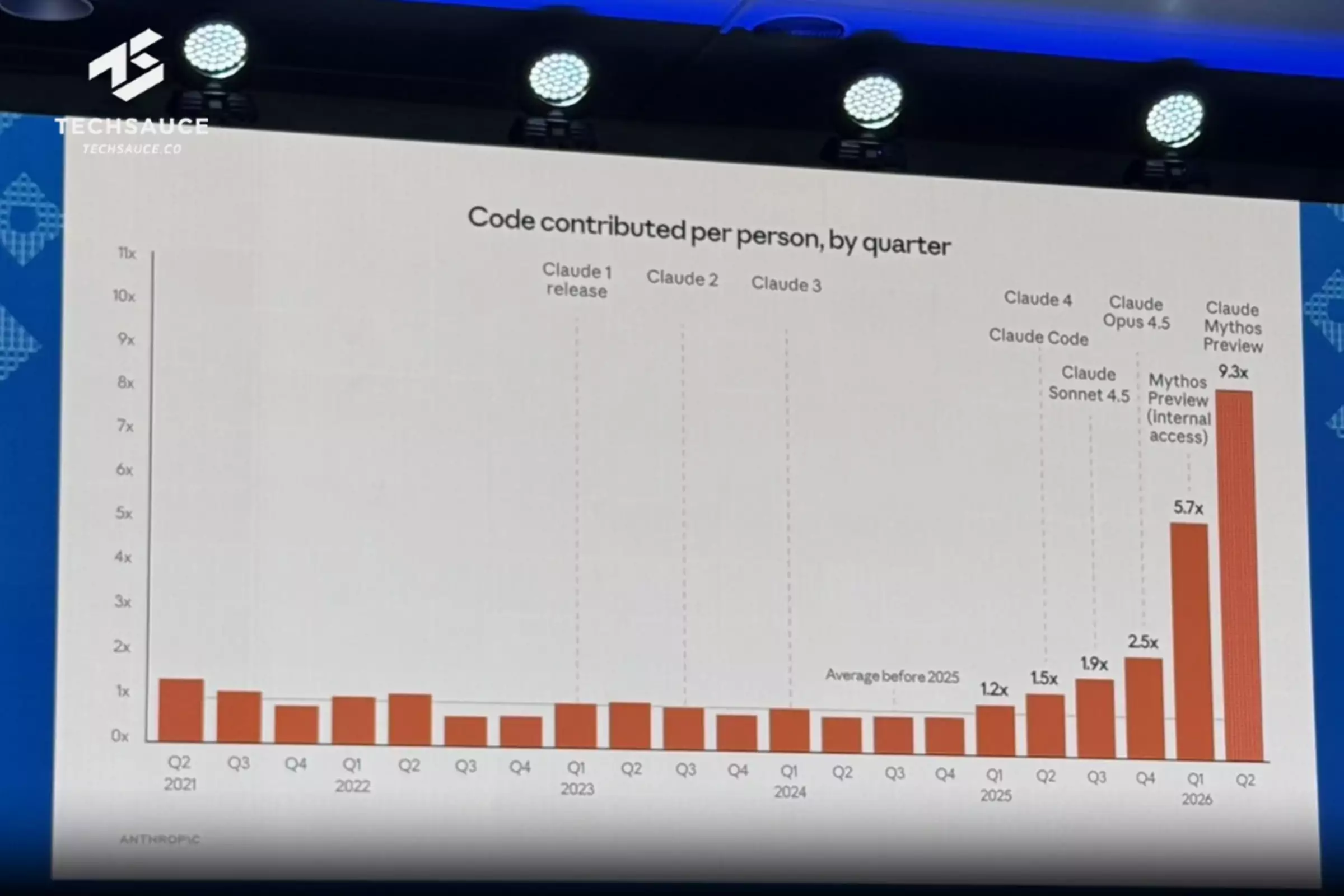
- Internal Anthropic data that he presented indicated that the amount of code researchers produce has risen almost 10-fold compared with the company's early days. A slide showed that in the second quarter of 2026, code volume per person was 9.3 times higher than the average before 2025.
- However, progress in coding cuts both ways, because AI that helps build cyber defences can also be used to attack systems.
- He sees the same thing happening in science and robotics, which could change the rate at which the global economy produces new innovation.
First Signs That AI May Be Doing Frontier Science
- Clark said that in 2026 there are the first signs that AI systems may be capable of doing science at the frontier of knowledge.
- In mathematics, AI has been used to propose solutions to long-standing open problems, such as Navier-Stokes, one of the Millennium Prize problems, as well as the Jacobian Conjecture and Erdős problems.
- In many cases, AI did not just help with calculations but contributed key ideas that led to the solution.
- In biology, researchers have begun using AI to design viruses from scratch and to search for compounds with potential to become drugs. Some drugs in whose design AI played a significant role have already moved into testing.
- In robotics, AI can increasingly operate laboratory equipment on its own, allowing experiments in biology, materials science, batteries and fuel cells to move faster than before.
- Clark sees it as significant that these abilities do not come from separate kinds of technology. They can come from the same foundation model.
- He calls systems such as Claude, ChatGPT and Gemini "Virtual Polymaths", capable of doing high-level science across many fields.
AI Exam Scores Leap From Single Digits to Near Perfect
- Clark gave the example of Humanity's Last Exam, a test that gathers hard problems from many fields, from chemistry, computer science and mathematics to classical literature and ecology.
- When it launched in January 2025, the best-scoring AI system managed only 8%.
- In the week of his lecture, Claude Opus 5.5, using tools, scored 67.7%, according to data he presented from Scale AI and CAIS.
- Another example is FrontierMath, a test of hard mathematics problems compiled and checked by professional mathematicians.
- When it launched in November 2024, the best AI system scored under 2%.
- Clark said the top score has since risen to 94%, achieved by GPT-6 Astra, according to Epoch AI.
- He said this pattern is not limited to a few fields. In the week before his lecture, he collected around 100 graphs of AI progress and found a pattern of rapid improvement across many disciplines.
- For him, this is evidence that AI capability is no longer growing slowly and is clearly accelerating.

When AI Found the Scientists' Answers Were Wrong
- Clark described TheoPhysEval, a study published on arXiv in October 2026, which used 50 theoretical physics problems whose answers had never been published.
- The problems were compiled from physicists' research around the world, so AI could not rely on memorising answers that had already appeared on the internet.
- He quoted a Facebook post by Suvrat Raju, one of the study's authors, who wrote that he did not know of any individual who could solve any significant fraction of the final collection of problems without AI assistance.
- Initial results showed GPT-6 Astra scoring in the late 80% range, with Claude Opus 5.5 close behind.
- But when the researchers examined the questions the AI got wrong, they found that the AI, Astra in particular, insisted its own answers were correct and that the experts' answer keys might be mistaken.
- When the experts went back and checked, they found errors hidden in their own calculations in several cases.
- After the answer keys were corrected, Astra's score rose to 98%, or 49 out of 50 questions.
- Clark compared the episode to a scene in films where the apprentice proves to the teacher that they are ready to move forward on their own.
- For him, it shows that AI is not only able to answer questions from what it has learned, but is beginning to show creativity in solving scientific problems that have never had answers.
- If AI can truly create new knowledge, that ability could extend to AI research itself and speed up the pace of technological progress even further.

A World Where One Scientist Has Thousands of AI Researchers
- Clark explained that economic growth comes partly from the discovery of new ideas and the accumulation of human capital.
- But producing a single researcher takes a long time. Training experts in some fields can take 10 to 15 years and millions of dollars, for only a small group of researchers.
- He returned to his opening joke. There is only one of him, and it took almost 40 years to build his experience. What would happen if copies of himself could be made to work at the same time, in their hundreds or thousands?
- AI could make this possible in the form of virtual researchers that can be created in large numbers instantly, as long as there is enough computing power.
- Human scientists might therefore become not less important but more capable, because they can oversee vast numbers of AI researchers working at once.
- Clark cited an economic model developed by a team at Anthropic. Under the assumption that AI can perform many kinds of work on its own and is widely adopted, one model predicts that US GDP could reach $44 trillion by 2030.
- He acknowledged that the number sounds exaggerated. But if the economy were to grow to that level, a great many new industries and inventions would be needed to support the expansion.
From Data Centres to Laboratories, the World Needs a New Round of Infrastructure
- Clark said that over the past 10 years he has travelled to meet many governments to urge them to invest in electricity, data centres and the AI supply chain.
- At the time, few policymakers took the warning seriously.
- Today, computing capacity and data centres are increasingly concentrated in the United States, China and the Middle East, while supply chains face constraints and price pressure.
- He sees building computing infrastructure as only the first phase of the change.
- The next phase is bringing AI into the physical world, with AI running scientific experiments and controlling robots in laboratories.
- The world therefore needs to invest in more scientific equipment, robots and laboratories. Otherwise, the ability to run real experiments could become the bottleneck for discovery.
- Clark cited UNESCO's estimate that the world has around 10 million scientists, which is still not enough for the volume of work and scientific equipment that already exists.
- He asked what would happen if 10 million human scientists could direct 1 billion virtual scientists, or more.
- The countries that invest in building this infrastructure and these supply chains today may be the ones that benefit most from AI.
Developing Countries Have a Chance to Leapfrog, but Must Prepare
- Clark sees this shift as creating opportunities for more than the technology superpowers.
- Developed countries with strong scientific ecosystems can use AI to raise the productivity of the researchers they already have.
- Developing countries that supply raw materials or resources in the supply chain can move up to build experimental and research capabilities.
- He proposed that these countries invest in experimental centres where human scientists work alongside AI scientists, which could help them leapfrog technologically without following the old path in full.
- However, infrastructure alone is not enough.
- If AI helps discover a vast number of new drugs but the clinical trial system can handle only a few, the benefits of those discoveries may never materialise.
- Clark therefore called on policymakers to speed up the process of taking research out of the laboratory and into hospitals, factories and real-world use.
The Smarter AI Gets, the More the World Must Decide What It Should Do
- After describing the economic opportunity, Clark turned to risk. He stressed that AI that can accelerate scientific discovery can also be used to build biological or cyber weapons.
- He said humanity must make at least three important decisions.
1. What Will We Allow AI to Do?
- Even though AI can do scientific research, that does not mean it should be left to do everything without human oversight.
- High-risk biological research in particular requires strict oversight and transparency.
- AI research itself is another area that calls for caution. Letting AI help develop the next generation of AI could speed up progress considerably, but it also raises the risk of losing control.
- Clark said labs such as Anthropic will need to decide how much oversight to apply to AI-driven research, and that rules will likely be needed to govern them too.
- He gave the example of a physics student in Tokyo who asked which experiments humans should do themselves and which should be left to AI. He admitted there is no clear answer yet.
2. Do Humans Need to Understand Everything AI Does?
- Clark said AI is now beginning to produce mathematical work that humans need time to study in order to understand the reasoning and the results.
- Within a few years, AI may be able to design scientific instruments itself, built to suit the way AI works rather than the way humans think.
- The key question is how much humans need to understand of all those tools and processes, and whether AI should be allowed to do work that humans cannot explain.
3. Are We Bold Enough to Imagine a World Very Different From Today's?
- Clark recalled that as a child he worried the 21st century would be filled with crises of population, resources and the environment, so that humanity might not be able to sustain itself.
- Over time, however, he saw technology change constraints that once seemed impossible, from the rapidly falling price of solar power to the development of medicines.
- He also cited things he once never imagined would happen, such as using AI to decode animal sounds and rockets that can return to land on Earth.
- These examples make him believe AI could help humans solve many more problems for which no solution is yet in sight.
The Most Important Technology Humanity Has Built, and One That Demands Restraint
- Clark sees AI as the most important technology humanity has ever built, one that could help address problems that threaten humanity's future.
- At the same time, risk is an inseparable part of the technology.
- He called on governments, scientists and AI companies to work together on serious rules, including oversight of the companies that develop the technology.
- The world should move quickly to build the infrastructure to benefit from AI, but it must develop AI's capabilities carefully and control the pace of progress.
- The central principle is to distinguish between what AI can do and what humans should allow AI to do.
- Clark closed by citing Carl Sagan, in the book Pale Blue Dot, who imagined future humans who are more capable, far-sighted and prudent than humans today.
- He said those are the qualities AI is demanding of humanity, including himself and the company he represents.
- But where Sagan imagined that humans would have hundreds of thousands of years to make themselves wiser and more prudent, Clark said we have a handful of years, less than a decade, easily.

In the end, what stands out from this lecture may not be only the prediction of how much better AI can get. It is the question Jack Clark left with the people shaping the global economy. How can we prepare the infrastructure to benefit from fast-moving technology? And can we build the rules, and the capacity for restraint, quickly enough to keep pace with that progress?
Source
- Jack Clark, Per Jacobsson Foundation Lecture, 2026 IMF-World Bank Annual Meetings, Bangkok (17 October 2026).
ลงทะเบียนเข้าสู่ระบบ เพื่ออ่านบทความฟรีไม่จำกัด


Small AI Can Create More and Better Jobs by Reaching Everyone
World Bank and IMF leaders discuss small AI that works on basic connectivity and can expand jobs and access to services....
 0
0

At SICW 2026, Singapore announced a Cybersecurity Professional Accreditation Framework, with a pilot set for 2027. Speakers urged organizations to automate the task, not the learni...
0

No one sees the whole cyber threat picture. At SICW 2026, Singapore launched its Cybersecurity Strategy 2026 and NC3 to defend at national scale with AI, raising a key question: wh...
0