
Huawei Unveils a New Vision for Telecom: From Selling Connectivity to Monetizing AI
At MWC Shanghai 2026, Huawei introduced a new vision for the telecommunications industry under the theme "Advancing All Intelligence." The company showcased its Service-Network-Compute Integration strategy, aiming to help telecom operators generate revenue not only from traditional data traffic but also from the rapidly growing AI economy.

AI Is Redefining the Role of Mobile Networks
David Wang, Huawei's Deputy Chairman of the Board and Rotating Chairman, said that over the past four decades, each generation of mobile technology has driven industry growth by improving spectrum efficiency, simplifying network architecture, and enabling new services.
However, in the AI era, mobile networks will no longer serve merely as data transmission infrastructure. Instead, they must support intelligent services, AI models, and AI agents that require real-time connectivity, ultra-low latency, and high-performance computing.
Six Priorities Shaping the Future of Mobile Communications
Huawei believes the next decade of telecom innovation will be defined by six key priorities:
- Developing new services and capabilities for future mobile communication systems
- Integrating AI into mobile communications
- Building integrated satellite-ground network architecture
- Promoting sustainable spectrum planning and allocation
- Defining AI-native core network standards
- Exploring new business models for mobile services
From Byte Monetization to Token Monetization
One of Huawei's key messages at MWC Shanghai 2026 was the industry's transition from Byte Monetization to Token Monetization.
Traditionally, telecom operators have generated revenue by selling data plans, network speed, and bandwidth. In the AI era, however, services such as AI assistants, AI glasses, smart home assistants, and AI agents are expected to become new revenue drivers, requiring high-performance, intelligent networks.
5G-A Will Become the Foundation of AI Services
Huawei stated that the global number of 5G-Advanced (5G-A) users has already surpassed 100 million. The company is working with telecom operators worldwide, including those in Thailand, to explore 5G-A Experience Monetization.
The goal is to make 5G-A more than just the next generation of mobile technology. It is expected to help operators retain premium subscribers, increase Average Revenue Per User (ARPU), and introduce new AI-driven services.
High Uplink Becomes a Competitive Advantage
Huawei emphasized that High Uplink will become a critical network capability in the AI era.
Unlike conventional mobile applications that primarily consume download bandwidth, AI-powered services continuously upload data for real-time processing.
For example, AI glasses capable of real-time translation or interactive exhibition guidance require approximately 20 Mbps uplink speed, making guaranteed upload performance, low latency, and network reliability increasingly important for telecom operators.
U6 GHz: A Key Spectrum for the AI Era
Huawei also highlighted Upper 6 GHz (U6 GHz) as one of the most important spectrum bands for next-generation mobile networks.
The company noted that more than 20 countries and regions have already designated U6 GHz for International Mobile Telecommunications (IMT), covering nearly 80% of the global population.
Huawei expects 2026 to mark the beginning of commercial U6 GHz deployments, with the Middle East leading the way, followed by selected operators in Hong Kong and Macao.
Introducing the AI-Centric Target Network
On the infrastructure side, Huawei unveiled its AI-Centric Target Network, a new network architecture designed to integrate connectivity and computing.
Rather than focusing solely on transporting traffic, future networks will support real-time interaction while dynamically scheduling computing resources across the entire network. In other words, connecting to the network will increasingly mean accessing AI computing power.
AI Will Power Autonomous Networks
Huawei is also advancing Level-4 Autonomous Networks, using AI to automate network maintenance, optimization, energy efficiency, and user experience management.
In 2026, Huawei plans to work with operators in multiple regions to deploy domain-specific AI across wireless and transport networks. This will enable differentiated network services for scenarios such as high-speed rail, large event venues, and university campuses.
A Turning Point for the Telecom Industry
According to Huawei, AI is driving a fundamental transformation of the telecommunications industry.
Competition will no longer focus solely on network speed or data volume. Instead, operators will compete on AI readiness, service experience, and their ability to integrate connectivity with computing power.
Huawei believes this shift represents a significant opportunity for operators to embrace Token Monetization, positioning mobile networks as the foundational infrastructure of the future AI economy.
ลงทะเบียนเข้าสู่ระบบ เพื่ออ่านบทความฟรีไม่จำกัด

KBank Partners with Techsauce to Host "Empower The Future Economy"
KBank and Techsauce host "Empower The Future Economy," an affiliate event held during the IMF-World Bank Group Annual Meetings 2026, featuring Deputy PM Suphajee Suthumpun and lead...
 0
0

FROM LAB TO MARKET SPACE-F BATCH 7 KEY TAKEAWAYS AT TECHSAUCE GLOBAL SUMMIT 2026
สรุปไฮไลท์ SPACE-F ในงาน Techsauce Global Summit 2026 เผยทิศทาง FoodTech ไทย จาก Kitchen of the World สู่ศูนย์กลางนวัตกรรมอาหารระดับโลก...
0
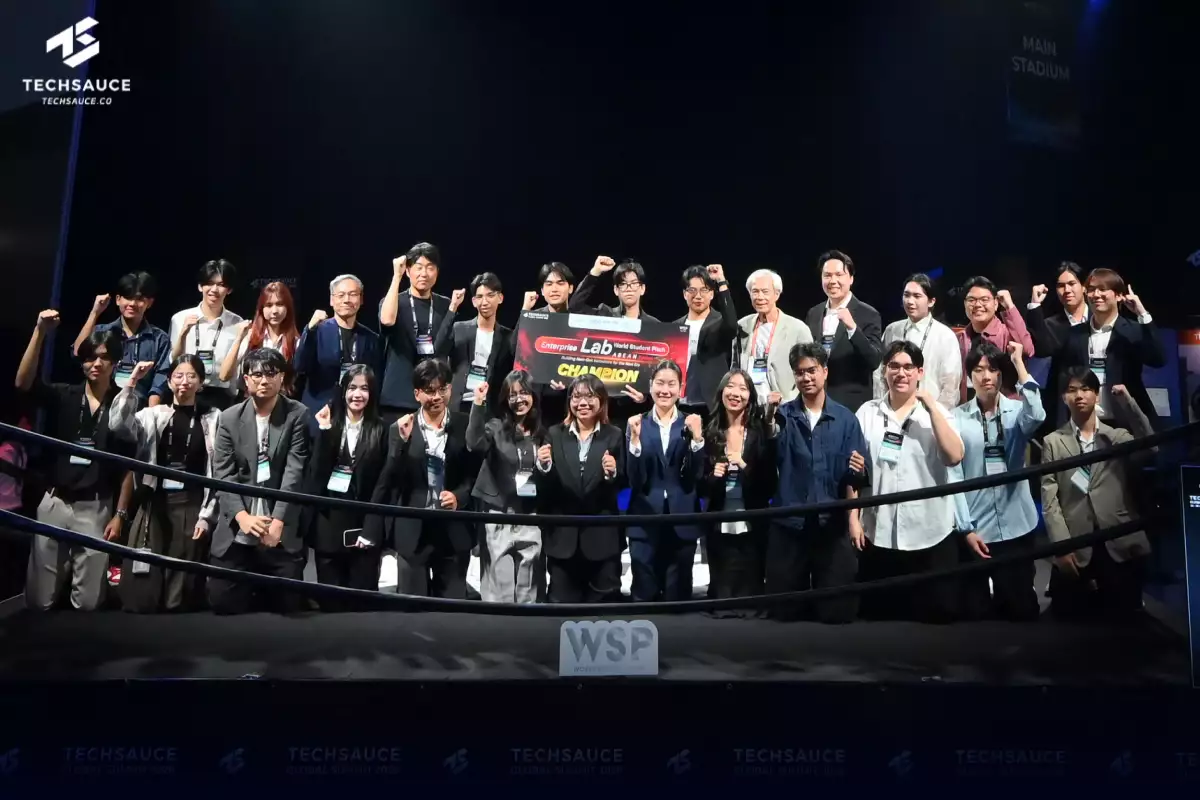
Student team Ctrl_A took the Grand Prize at Enterprise Lab: World Student Pitch ASEAN Edition 2026 with YARDS, an AI scrap steel grading system, beating eight other finalists at Te...
0