
Toys Are Regulated More Than Superintelligence? Jack Clark on Governing AI at the IMF-World Bank 2026

I think it's worse than you describe. I think it's Formula 1 at night without maybe brakes in the cars.
Those were the words of Jack Clark, co-founder of Anthropic, after Kristalina Georgieva, Managing Director of the IMF, compared the speed of AI to a Formula 1 race. The exchange took place during the panel "AI and the Global Economy: From Risk to Opportunity" at the Annual Meetings of the IMF and the World Bank Group in Bangkok on October 16, 2026.
Georgieva sees AI advancing as fast as an F1 car at full throttle. The question, in her view, is how the world will put up barriers and safety standards so that a car that loses control does not fly off the track and hurt the people watching.
Clark, however, believes the situation may be more worrying than that. Not only is the car going fast, but we may not be able to see the road ahead, and we do not even know whether the car has brakes.
AI Makes Workers Faster, but Has Not Yet Transformed Whole Organizations
Georgieva opened this part of the discussion by noting that AI is developing and spreading faster than any technology we have seen before. Countries that are part of the AI value chain are already enjoying the economic growth it brings, but there are still only a few of them. Meanwhile, AI's impact has spread widely enough that financial stability regulators now need to keep a close eye on it.
Ayesha Khanna, co-founder and CEO of Addo AI, observed that while consumers have adopted AI quickly, many organizations have yet to turn that usage into business results.
Until now, many companies have experimented with AI by having employees start using it individually, for example by rolling out AI copilots to help with their work. Employees may feel they are working faster, but gains at the individual level do not necessarily translate into better workflows or higher productivity for the company as a whole.
After several years of trying this approach, many organizations are now rethinking how to redesign their workflows so that AI delivers real results.
Tobias Meyer, CEO of DHL Group, explained that DHL does not fund every proposal to use AI. Instead, it invests selectively in the right use cases, especially processes that involve handling large amounts of data, such as customs clearance and customer service.
The turning point for DHL was the arrival of agentic AI, which made it possible to design systems in which AI connects to the company's databases and specialized systems to produce accurate results that can be acted on.
When a customer wants to know where a parcel is, for example, the business does not want a vague answer from AI. It needs the parcel's exact location.
Tiff Macklem, Governor of the Bank of Canada, believes the economic benefits of AI will only be fully realized when the technology spreads to companies across the economy, rather than staying concentrated among technology companies, major cloud providers, and chipmakers.
Productivity growth is the foundation for raising living standards, he noted, but adopting AI must go hand in hand with managing its risks. Otherwise, society may not get the benefits it should.
Georgieva believes the global economy is still in the early stages of this transition. We are starting to see AI raise the productivity of individual workers, but we have yet to see a major shift across the economy as a whole.
She invoked Amara's Law, which holds that people tend to overestimate the effect of a new technology in the short run and underestimate it in the long run.
Clark, however, argued that AI has certain qualities that set it apart from past technologies.
He explained that when an organization buys an airplane, a microscope, or a mainframe computer, it still has to do a great deal of installation and process change before it sees any benefit. An AI system, by contrast, can show up and ask, "What do you want me to help with?"
That difference may allow AI to start generating productivity gains in large organizations faster than earlier technologies did.
Khanna noted, however, that measuring success by speed or output volume may not be enough. Organizations should ask whether AI helps them make better decisions and whether the quality of their results has actually improved.
After all, working faster does not always lead to better outcomes.
Who Benefits from AI, and Who Might Be Left Behind
Georgieva noted that for every country to benefit from AI, at least three basic conditions must be in place.
- The first is digital infrastructure and access to electricity, which many parts of the world still lack.
- The second is a population with the skills to work alongside new technology.
- The third is spreading AI across sectors of the economy, including agriculture, healthcare, and education, rather than confining it to technology companies.
Macklem explained that, historically, major technologies have usually created more new jobs than they eliminated. But we should not assume AI will always produce the same result, because AI may be capable enough to do some of the new jobs itself.
Georgieva cited an IMF study showing that the labor market is starting to demand new skills and new kinds of work. About 10% of jobs fall into a category that requires skills or tasks that either did not exist before or have changed, and these jobs pay more.
Routine jobs, on the other hand, face growing risk. Although AI is driving investment and demand for service workers, many service jobs pay less than the careers young people once expected.
Khanna pointed to Singapore as an example of a country trying to manage this transition. It does not stop at retraining citizens. It also supports training and provides funding to help businesses adapt, so they can actually hire workers who have gone through reskilling.
For Macklem, this transition is not the responsibility of governments alone. Companies must also take responsibility for their workers. If technology makes certain roles less important, companies should help employees build new skills so they can move into other parts of the business.
He drew a comparison with free trade, which benefits the economy as a whole but also costs some people their jobs and income. Without a system to help those affected, resentment can lead to a social backlash that undermines the benefits for everyone.
AI could face the same situation if society cannot take care of those who lose out from the transition.
When AI Moves Faster Than the Rules, Who Builds the Barriers?
Georgieva acknowledged that governments alone are unlikely to be able to regulate a technology that is changing this quickly, because the public sector still lacks sufficient knowledge of the technology.
She therefore sees inviting technology companies to take part in regulating themselves as a sensible approach. Even so, AI developers should not be left to make all the safety decisions on their own.
What is needed is a system in which different parts of society share that responsibility.
Georgieva believes the countries developing AI should take the lead, especially the United States and China as major AI producers, along with India, which plays an important role in developing small models, and countries that are part of the technology supply chain, such as chipmakers.
International organizations such as the IMF should take responsibility in their own areas of expertise: productivity growth, labor markets, and risks to financial stability.
The problem is that cooperation among these parties is moving more slowly than the technology itself.
That is why Georgieva compared the situation to a Formula 1 race in which the cars are accelerating but there are not yet enough barriers or safety standards. If a car flies off the track, it could crash into people who have nothing to do with the race.
She also recalled how Pope Francis raised the ethics of AI at the G7 summit, to stress that however much AI benefits humanity, society still needs to agree on what the technology should not do.
Clark said the situation may be worse than Georgieva described, because AI is really more like a Formula 1 race at night, and the cars may not have brakes.
But he believes there are still things that can be done. At the very least, there needs to be telemetry tracking how the car is performing, lights so the drivers can see the road, and checks to make sure the car really has brakes.
For AI, this means creating shared standards, disclosing the information needed for oversight, and having risk safeguards that can be evaluated.
Clark then offered an example closer to home: children's toys, which must carry labels, meet testing standards, and comply with safety requirements. Even if a child puts a toy in their mouth, it must not cause harm.
"It's remarkable to me that the toys I buy for my children are regulated more than the literal superintelligence I work on at my day job."
Just as important, countries can trade toys with one another because they share testing standards and recognize each other's test results.
Clark therefore believes AI systems should likewise have safety standards that can be shared across countries.
The moderator, Quest, immediately pushed back, pointing out that Clark is himself one of the people building the technology, so his proposal sounded like a call for someone else to do something.
Clark replied that Anthropic already tests its systems, publishes details of those tests, and voluntarily runs systems that track how its models operate. It also allows external evaluators to examine parts of its systems.
He stressed, however, that in the long run these things should not depend on companies volunteering.
He supports governments in the countries that develop AI setting clear and reasonable safety standards, because such standards will build trust in the technology and support economic growth.
Countries That Use AI Must Also Have the Right to Test It
Khanna believes that what the world needs is not just warnings or regulations, but tools that actually help organizations protect themselves from risk, particularly open-source tools for dealing with cyber threats.
Meyer proposed starting with shared principles and developing standards along the lines of those from the International Organization for Standardization (ISO), because standards that everyone understands in the same way lay the groundwork for enforcement in the future.
He also cautioned that AI systems must be designed with the distribution of economic value in mind, rather than letting the benefits concentrate in a handful of technology companies. Small and medium-sized businesses should benefit too, and organizations should design their systems so that they do not depend too heavily on any single provider.
Macklem broadened the discussion to the role of countries that use AI. He argued that waiting for the United States, China, and Europe to agree on a major set of regulations may not keep up with the speed of the technology.
What is needed instead is cooperation between the public and private sectors, with room for the countries that use the technology to take part as well.
As Macklem put it, these countries need access to the latest technology so that they can test their own systems as well.
This point matters for countries like Thailand that use AI from major developers, because AI governance should not end with whatever laws or standards exist in the countries that produce it.
If user countries lack technical experts, cannot access systems to test them, or do not have sufficiently independent oversight mechanisms, they may have to rely on assessments from developers or other countries, without being able to fully examine the risks of using these systems in their own context.
Clark proposed the idea of "test once, run anywhere," meaning that testing done in one country could be used in others.
This does not mean every AI system can be tested once and then be safe in every situation. Rather, it means creating standards that allow test results from one country to be recognized in another, with each country potentially bringing different expertise to the design of tests.
He believes many parties already share common ground on safety, such as preventing AI from being used to develop biological weapons or to carry out cyberattacks.
Georgieva also sees room to align the regulatory approaches of different countries, even though the United States, China, and the European Union take different paths. All of them share an interest in not letting those who use AI to cause harm get ahead of those who are trying to use it responsibly.
But a key question remains: who will check whether AI is violating these standards?
When Quest posed this question, Clark suggested starting with the AI Safety Institutes (AISIs) that a number of governments have set up.
These institutes have staff with technical expertise, can access AI systems through application programming interfaces (APIs) to run tests and assess risks, and are linked through international networks of cooperation. They could therefore become the starting point for a third-party oversight mechanism in the future.
Clark stressed, however, that this was only an initial idea he put forward during the discussion, not a fully considered policy proposal.
The panel did not settle who should independently audit AI, or how to make audit results trusted across borders. Still, the panelists broadly agreed on one thing: leaving technology companies to set and certify the safety of their own systems by themselves may no longer be enough.
For countries that use AI, including Thailand, the challenge is not only to bring in the technology to make their economies more efficient, but also to build the capacity to assess risks, gain access to testing tools, and take part in setting the standards that shape how AI is used within their own borders.
What the world seems to need is not just a faster car, but also a clear sense of where the car is heading, what safety systems it has, and who is responsible for checking that those systems actually work.
Reference: "AI and the Global Economy: From Risk to Opportunity" session at the 2026 Annual Meetings of the IMF and the World Bank Group
ลงทะเบียนเข้าสู่ระบบ เพื่ออ่านบทความฟรีไม่จำกัด

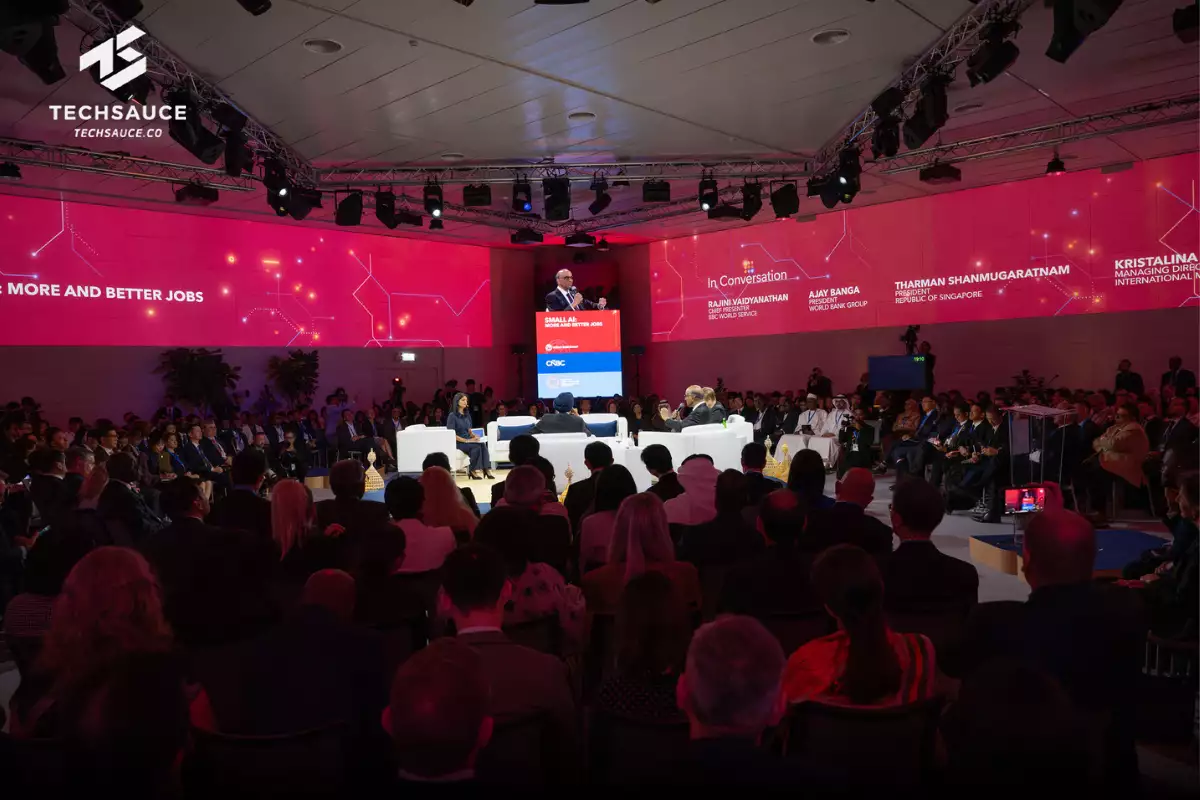
World Bank, IMF, and Singapore leaders explain how Small AI, simple tools that work even on a 3G phone, could help create jobs for 1.2 billion young people, and which sectors and p...
 0
Cloudflare Field CISO Volker Rath says AI is weakening traditional defenses. Organizations need Zero Trust, security teams that act as engineers, policy written as code, and clear ...
0

KBank and Techsauce hosted “EMPOWER THE FUTURE ECONOMY,” an affiliated program of the IMF–World Bank Group Annual Meetings 2026, with leaders from IFC, Standard Chartered Bank, Mic...
0