The Age of Symbiosis: How Amity, KBTG, and Eureka Global Are Redefining Corporate AI Innovation
At Techsauce Global Summit 2025, the conversation around Artificial Intelligence shifted from "what if" to "what now," marking a pivotal moment for corporate AI innovation. The industry has moved past the speculation of the last few years to face the reality of adoption. The focus is now on securing a measurable return on investment and managing the day-to-day collaboration between people and software.
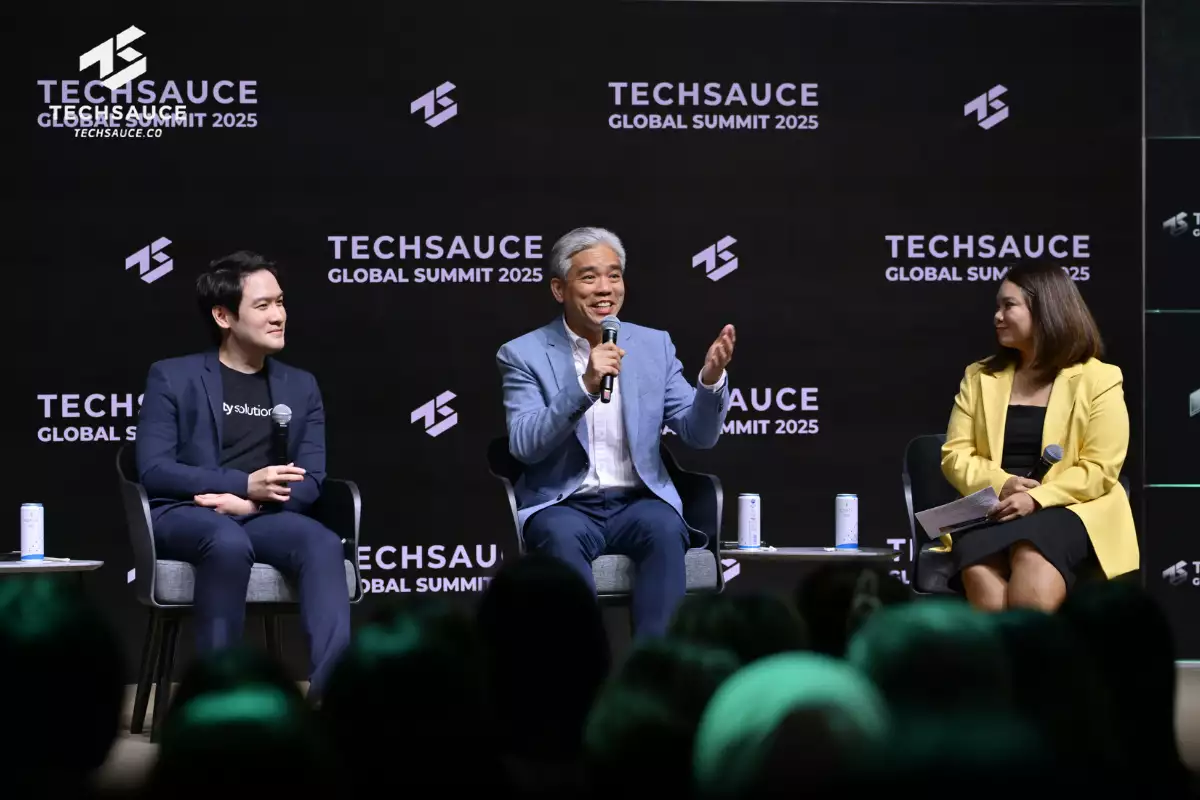
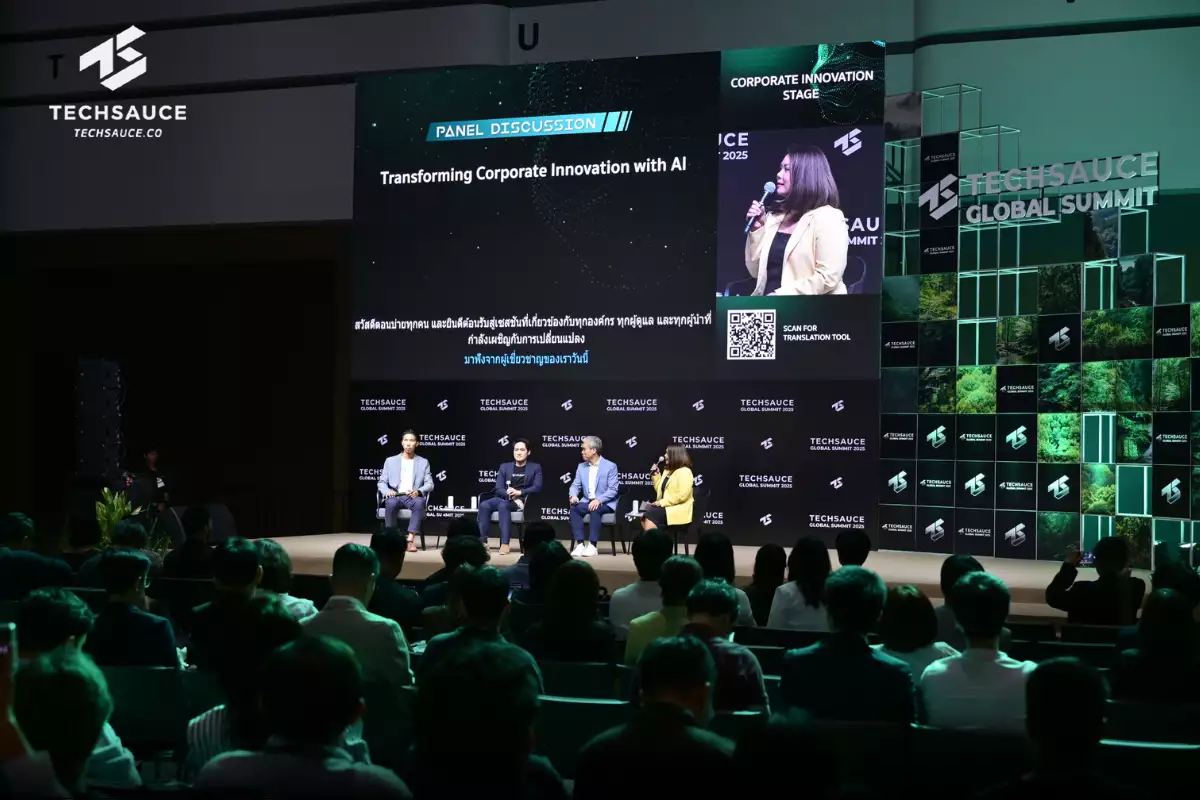
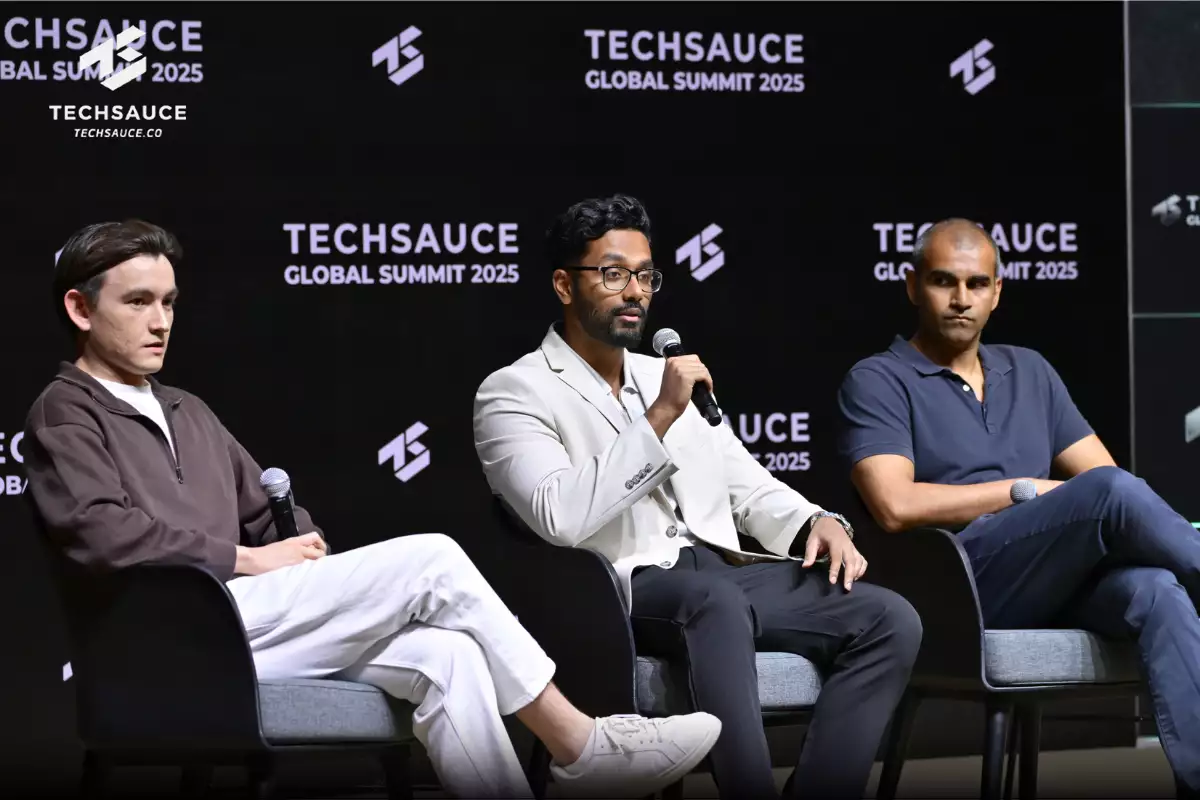
In a session titled "Transforming Corporate Innovation with AI," three industry leaders; Touchapon Kraisingkorn (Group CTO, Amity Group), Chetaphan "Joe" Siridanupath (Managing Director, KBTG), and Dr. Luis Kristhanin (CEO, Eureka Global). They dissected the reality of deploying AI at large scale. Moderated by Chonthicha Sangpan, the panel revealed that the bottleneck issue no longer lies within the technology, but in the context, the culture, and the ability to adapt.
Beyond the Interface: The Rise of Agentic AI
Touchapon Kraisingkorn opened the session with a provocative forecast regarding the death of the traditional User Interface (UI). Drawing on predictions from tech visionaries like Satya Nadella, he argued that the era of navigating websites, filling out forms, and clicking through menus is drawing to a close.
He explained that if we look back 30 years, humans interacted with other humans to get things done—calling a travel agent to book a flight, for instance. We then moved to a digital era where we interacted with UIs. Now, we are circling back to a natural interaction model, but this time, the "agent" is digital. "In the future, Generative AI will be the new user interface," he stated, noting that Amity is already seeing this shift turn into reality with the rise of "Agent Mode" in tools like ChatGPT.
To contextualize this rapid evolution, Touchapon outlined the five distinct phases of AI development:
- Level 1: Chatbot (2022): Simple Q&A interactions where the AI responds immediately.
- Level 2: Reasoner: AI that possesses "System 2" thinking—it pauses to "think" and reason through a problem before answering.
- Level 3: Agentic AI (Current Era): This is the massive leap we are experiencing now. The AI doesn't just give advice; it executes. It can browse the web, log into systems, buy a pizza, or book a cab autonomously without human hand-holding.
- Level 4: Innovator: A near-future stage where AI begins to discover new science, such as inventing new medicines or solving mathematical problems that have stumped humans for decades.
- Level 5: Organization: A theoretical future where an AI could potentially run an entire operational entity.
Currently, we are firmly in the "Agentic" phase. The implications for corporations are massive: it’s no longer about building a better app interface; it’s about building systems that can autonomously perform work.
In the future, no one is going to use a UI anymore... The whole [corporate] thing is built on this one fundamental point. And we see that actually turning out to be true.
— Touchapon Kraisingkorn
The "Correct but Not Right" Paradox
As AI permeates legacy institutions, a new challenge has emerged: the gap between data accuracy and business context. Touchapon shared a revealing case study involving Lotus's (CP Axtra), a retail giant with thousands of stores. The objective seemed straightforward: deploy an AI to analyze daily sales figures, compare them to the previous year, and explain why sales were dropping or rising.
However, the reality was far more complex. Sales fluctuate based on granular factors: categories, channels, local events, and inventory nuances. When Amity first deployed the system, the AI could crunch the numbers perfectly. It could tell you that sales dropped and correlate it to data points. But the answers, while mathematically accurate, were often useless to a store manager.
Touchapon described this as the "Correct but Not Right" paradox. The AI’s answer was technically correct based on the prompt, but it was not "right" in the context of business strategy or operational reality. It lacked the intuition of a veteran store manager.
- The Problem: Intelligence is no longer the bottleneck—context is. The AI has the brainpower but lacks the knowledge of the organization.
- The Solution: Amity had to interview human experts to "codify" their intuition. They documented how a human expert solves a problem and trained the AI on that process, not just the data. This proved that for AI to be effective, it must be taught the specific context of the business, effectively bridging the gap between raw intelligence and practical wisdom.
From "Innovation Theater" to Tangible ROI
For the banking sector, the stakes of AI adoption are significantly higher. Chetaphan (Joe) Siridanupath of KBTG emphasized that the days of "innovation theater," where banks hosted hackathons merely to generate PR buzz—are long gone.
While KBTG still fosters innovation, the directive has shifted. The focus is now strictly on commercial value, Return on Equity (ROE), and strategic alignment with core business pillars like Wealth Tech, RegTech, and Fraud Prevention. "Innovators must think through customer pain points and business viability from Day One," Chetaphan noted.
However, scaling AI in banking faces a unique hurdle: Trust. In a regulated industry, the "Black Box" nature of Generative AI poses a significant risk.
- Explainability vs. Accuracy: A bank cannot deny a loan or suggest an investment portfolio based on an AI "hunch." The decision must be explainable for compliance and operational risk management.
- Guardrails: Chetaphan illustrated this with a chatbot example. If a customer asks, "Can I buy KBank stock now?" the AI cannot hallucinate an answer or give advice that breaches regulatory licenses. It must be 100% accurate, not 99%.
Despite these constraints, KBTG is aggressively pursuing Democratization and Monetization. Internally, they are empowering product managers and designers to use AI to generate code and prototypes instantly, bypassing traditional development bottlenecks. Externally, they are pivoting to commercialize their internal tools. Recognizing that if a tool works for KBTG, it will work for others, they are packaging their internal AI innovations as "Software as a Service" (SaaS) products, transforming the IT department from a cost center into a revenue generator.
We don't have to match [scammers] technologically in every way; we just have to win the war on not letting the money go out easily.
— Chetaphan (Joe) Siridanupath (on using AI for fraud prevention)
Symbiosis: The Human-AI Equation
Dr. Luis Kristhanin of Eureka Global brought the conversation back to the most critical variable: the human element. He opened by critiquing the reactive leadership style common in many organizations—the "hope for the best" approach. In a VUCA (Volatile, Uncertain, Complex, Ambiguous) world, hoping for the best is a strategy for obsolescence. Organizations must instead be proactive, using AI not as a crutch, but as a tool for "Symbiosis."
For Dr. Luis, the future isn't about AI replacing humans, but about integrating the two species to co-create impact. He illustrated this through the "Work-Based Education" model used by the Panyapiwat Institute of Management (PIM) and 7-Eleven.
In this model, students don't just sit in classrooms; they spend half their degree practicing in actual 7-Eleven stores. They learn the "human" side of the business—how to brew coffee, how to manage customers. Crucially, when they return to the classroom, they are required to propose improvements based on their field observations. This creates a massive, continuous feedback loop where thousands of students are constantly feeding innovative ideas back into the corporate strategy.
This is the blueprint for AI adoption: continuous human observation powered by technology. Dr. Luis argued that technology is merely an enabler. The real driver is a culture that encourages curiosity and allows employees—from students to executives—to identify pain points and use tools to solve them. Innovation doesn't happen in a lab; it happens when curious humans are empowered to improve their daily work.
2026 and Beyond: Adapt or Obsolete
As the session concluded, the speakers offered a pragmatic roadmap for the coming year. The consensus was clear: the technology will continue to accelerate at a breakneck pace, but the competitive advantage for 2026 lies in human adaptability and "learning by doing."
- Touchapon on Productivity: The definition of a job is changing. Drawing an analogy to the past, he noted that "computer" used to be a job title for humans who did calculations. That job disappeared, but those humans didn't; they adapted to use calculators. Similarly, as coding agents begin to replace 50% of routine programming work, humans must not fear obsolescence but instead aim to become 10x more productive.
- Dr. Luis on Curiosity: To survive in an "Aged Society" and a tech-driven world, leaders must cultivate deep curiosity. It is about remaining open to new things—listening, trying, and integrating the digital with the human.
- Chetaphan on Leading by Doing: There is a trap in the C-suite where executives assign AI research to subordinates and wait for a report. Chetaphan warned that this is a failure of leadership. To truly understand the limitations and opportunities of AI, leaders must get their hands dirty. They must use the tools personally to understand the user experience and set the tone from the top.
As the industry marches toward 2026, the winners will not be those with the most powerful chips or the largest data centers. The winners will be the organizations that can successfully navigate the "symbiosis" of human judgment and agentic AI—balancing the efficiency of machines with the context and creativity of their people.
Based on the session: “Transforming Corporate Innovation with AI” at the Techsauce Global Summit 2025.
ลงทะเบียนเข้าสู่ระบบ เพื่ออ่านบทความฟรีไม่จำกัด


Decoding Nagoya: From Automotive Capital to a “Global Sandbox” for Deep Tech and Innovation
We no longer want to be known solely as Japan's number one industrial city." Nagoya is transforming into a global innovation hub. Discover how Central Japan is fusing Deep Tech wit...
 0
0
The ASEAN Expansion 'Disaster': VCs Decode the Downturn Playbook for Resilient Startups
How can startups survive the downturn? VCs get candid, revealing why the default SEA expansion strategy is a 'disaster' and why just 'surviving' is a trap....
0

Growth Forum 2025: Integrating Growth Strategy, Psychology, and Mindfulness for the AI Era
Highlights from Growth Forum 2025. Learn new growth strategies, consumer psychology insights from Gary van Broekhoven, and mindfulness techniques for the AI era....
0