
WEF 2026: Suphajee Suthumpun Reveals New Thailand Global Trade Strategy

“The most vital currency in the world today isn't the US Dollar, the Yuan, or the Baht. In the realm of global trade, the currency that matters most is Trust.”
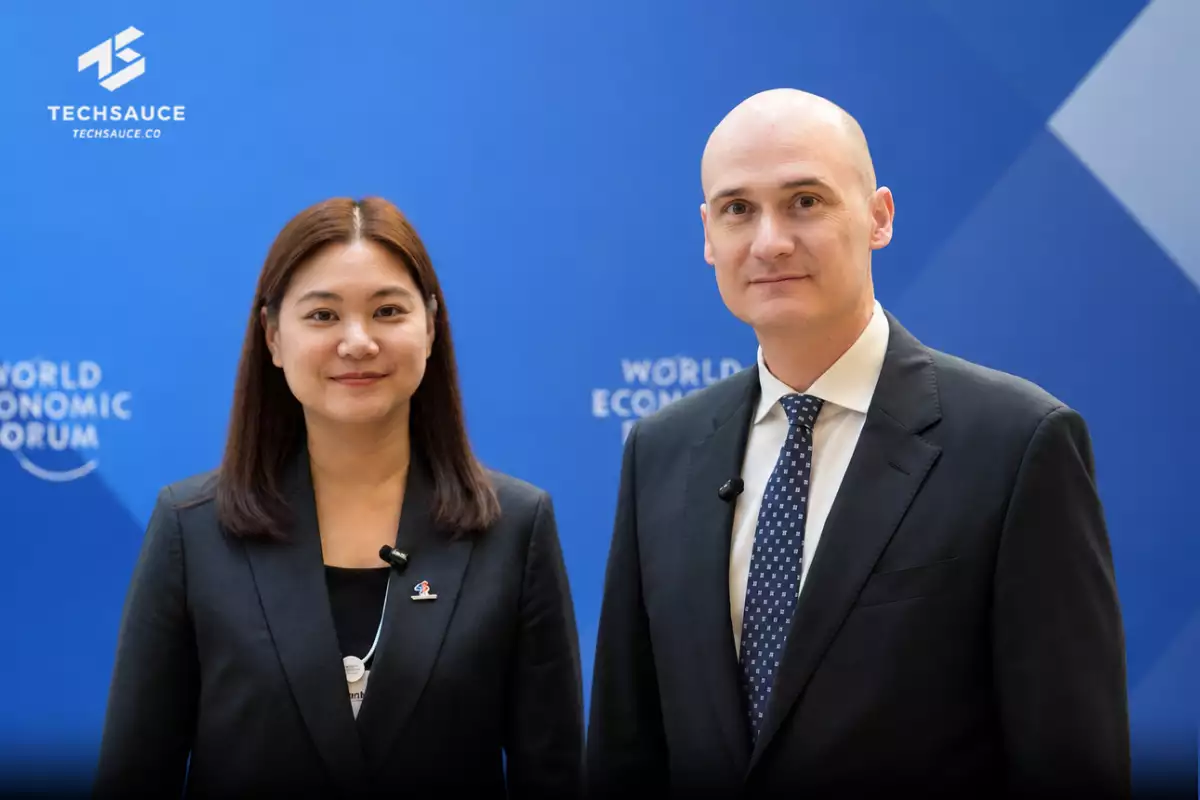
Techsauce recently sat down with Suphajee Suthumpun, the Minister of Commerce of Thailand, to discuss the new Thailand Global Trade Strategy following her high-level meetings at the World Economic Forum (WEF) 2026. Representing "Team Thailand," her mission was clear: Thailand is not just showing up—it is declaring its status as a global strategic hub ready to navigate the new rules of international trade.
Transitioning Thailand From Tourist Destination to Global Strategic Point
Although the world often views Thailand through the lens of tourism and culture, this time the nation is positioning itself as a global strategic hub for trade.
Ms. Suphajee explained that Thailand is ready to partner with everyone, leveraging its strategic location at the heart of Asia, a natural bridge connecting the East and the West.
Beyond geography, Thailand holds a competitive edge through its 14 Free Trade Agreements (FTAs). This allows investors who establish a base in Thailand to immediately use the country as a gateway to export goods to these markets with significant tax privileges. This remains one of Thailand’s most critical selling points.
The question we are asking is 'How do we integrate ourselves into their supply chains?'
Ms. Suphajee revealed that Thailand’s negotiation strategy with international partners has evolved. Gone are the days of simple transactional talks about what Thailand can sell to others or what they can sell to us.
Instead, Thailand aims to embed itself directly into its partners' supply chains, collaborating on production to jointly export to third and fourth markets.
Revolutionizing Trade with DIFA
Thailand is accelerating the push for the Digital Framework Agreement (DIFA), an ASEAN initiative designed to harmonize digital standards, regulations, cross-border data flows, and infrastructure connectivity across all 11 member nations.
Ms. Suphajee revealed that negotiations are already over 76% complete, with the agreement expected to be finalized by April in time for an official signing at the ASEAN Summit.
Once implemented, DIFA will serve as a vital trading framework for Thais and the wider region, effectively transforming ASEAN into a single unified market of over 600 million consumers.
Crucially, DIFA will also integrate with the financial sector to facilitate Cross-border Payments (such as regional QR Pay), a move set to drive a massive increase in trade transaction volumes.
Major Deals on the Horizon
Ms. Suphajee highlighted that "Team Thailand’s" mission to Davos 2026 has yielded significant progress on several major deals worth watching:
- Thailand-Canada FTA: The goal is to conclude negotiations within this year.
- Thailand-EFTA FTA (Switzerland): Negotiations with Switzerland are underway, with the agreement expected to be finalized and come into force by January 1, 2027.
- WIPO (Intellectual Property): Discussions focused on empowering the younger generation regarding patents, copyrights, and trademark registration. The aim is to build an ecosystem where creators and new entrepreneurs understand how to protect their work, transforming content into revenue-generating assets (IP)—similar to the successful model established with LINE.
The "Fast Pass" and Investment Surge
Ms. Suphajee sees current investor confidence clearly reflected in last year’s investment promotion figures, which surged to 1.33 trillion baht—a 94% increase from the previous year. Approximately 980 billion baht of this total came from foreign direct investment.
The key challenge for 2026 is to transform these commitments into actual investments by making the approval process more seamless.
To achieve this, the government is driving the "Fast Pass" initiative to remove licensing bottlenecks and enhance transparency. This specifically targets "Industries of the Future"—such as Data Centers, AI, and Semiconductors—which require clean energy. Thailand is already a regional leader in this infrastructure, and the government stands ready to immediately provide whatever support investors require.
Three Mandates for Thai Entrepreneurs
Finally, Ms. Suphajee left a message for Thai entrepreneurs, emphasizing that they must urgently adapt in three key areas:
1. Sustainability is a ‘Must’
Ms. Suphajee explained that sustainability is no longer just a trend—it is the new global rulebook. European markets have already begun enforcing Carbon Footprint and Carbon Credit standards.
If we do not adapt, trading will become increasingly difficult. The government must also step up alongside the private sector with support mechanisms, such as incentives and Direct PPA (Direct Power Purchase Agreements) for clean energy, to facilitate this transition.
2. Harness AI with Awareness
Ms. Suphajee views AI as both an opportunity and a challenge. Given AI’s capability to access, analyze, and process data rapidly, it can significantly boost our Productivity and Predictability.
This allows businesses to discover new business models and markets at a lower cost. However, it is crucial that we use this technology responsibly and with a deep understanding of its implications.
3. Trust is the Most Valuable Currency
The most critical currency in trade is Trust. If we negotiate a deal where we only seek our own gain, or where the other party only seeks theirs, that relationship is not sustainable. But if we can stand firm as a trusted partner, seeking mutual benefits and shared solutions, that is what will ensure our success.
Ms. Suphajee advised Thai entrepreneurs that in trade, negotiation, and business, "We must clearly identify which 'missing jigsaw piece' we are for our partners, and figure out how we can fill that gap to create shared value."
If we can successfully fill that gap, Ms. Suphajee believes that our country, our organizations, and even our people will be able to stand firm and thrive in a world full of volatility and change.
Source: Special interview with Suphajee Suthumpun, Minister of Commerce, from the World Economic Forum 2026.
ลงทะเบียนเข้าสู่ระบบ เพื่ออ่านบทความฟรีไม่จำกัด


Ajay Banga Says Aid Can Ease Poverty but Jobs Give People a Future
Ajay Banga explains why jobs, private capital and opportunity are central to the World Bank’s approach to poverty....
 0
0
It is really about the intersection of opportunity and risk. How do you invest at the right time while also managing the risk that some assets may lose value in the future?"...
0
Conversation with Sigve Brekke: Shaping Thailand’s Competitive Digital Future
Discover Sigve Brekke’s unconventional leadership philosophy shared at Techsauce Global Summit 2025 from ice baths and emotional engagement to the “Tight-Loose-Tight” management st...
0