Marc Buckley: a Future Where 'Sustainability' Isn't the Answer and Symbiocene is Humanity's Only Path to Survival
In an era where the world faces a convergence of "Technology Supercycles"—including Quantum Computing, Generative AI, and Biotechnology—the key question echoing through innovation circles is not just “What will we build next?” but rather, "How can we evolve as fast as a world that is changing exponentially?" The answer, it seems, may lie in a new paradigm altogether: the Symbiocene.
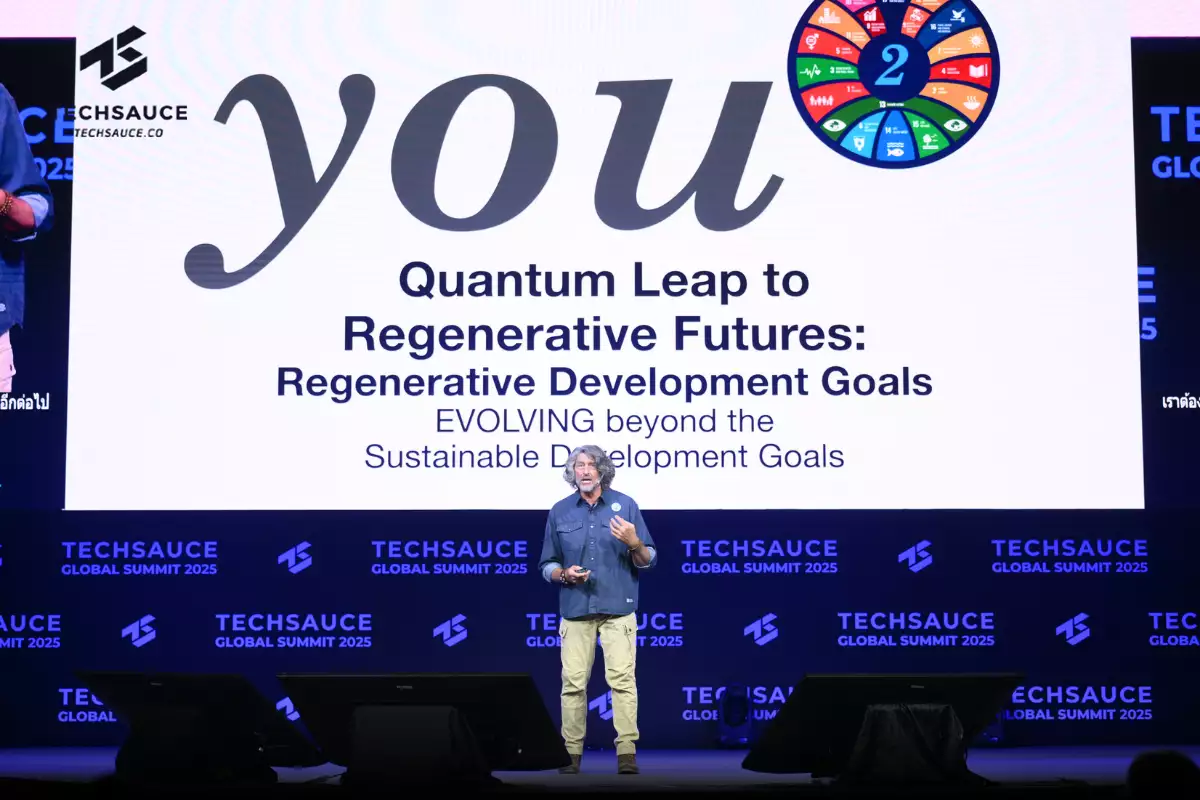
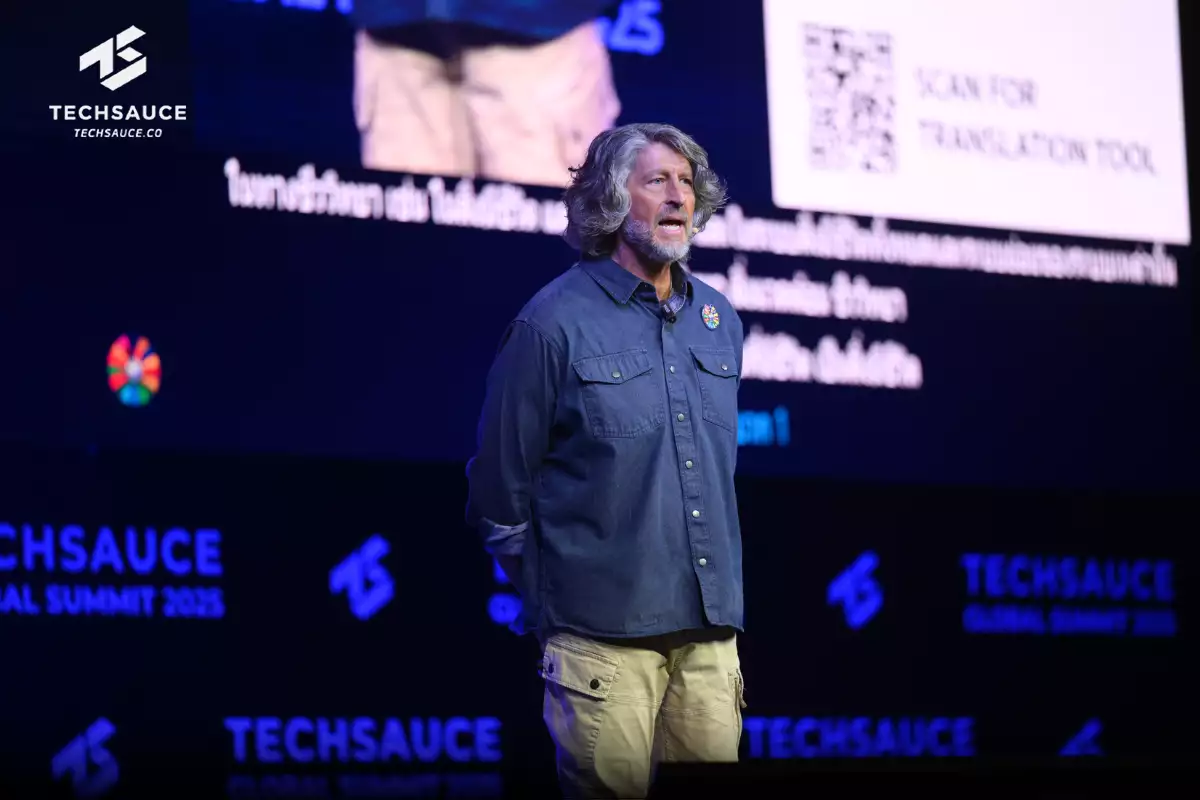 During the session, "Quantum Leap to Regenerative Futures: The Dawn of Symbiosis," regenerative futurist and ecological economist Marc Buckley delivered a message that was both powerful and profoundly challenging to our core beliefs. He began with a statement that commanded attention:
“In a world that is changing in an exponential manner every second of the day and evolving every second of the day, if you and I only improve incrementally, we will fall behind exponentially.”
This conversation was not merely a forecast of the future; it was a decoding of nature, which holds the answers to our survival, pointing to a goal far greater than "sustainability."
 The Illusion of Progress and a Call to Re-examine "Sustainability"
Have you ever closed your eyes and envisioned your "home"? Marc invited the audience of thousands to do just that before displaying an image of "Planet Earth" and asking a simple question: “Does anyone see this image as their home?”
The result was shocking: only a handful of people raised their hands. Marc revealed that after asking this same question to 500 million people worldwide, less than 0.000001% imagined the Earth as their home. “I'm sorry, but that's a huge problem. This is our only home.” he stated.
This very sense of disconnection is why we fail to solve global-scale problems. It is also reflected in the goal that so many of us are chasing: "Sustainability."
Marc offered a blunt critique of the concept: “Sustainability is not sustainable.”
“If you are only trying to achieve sustainability, you are stuck in the past,” he argued, comparing it to Maslow's Hierarchy of Needs. He explained that sustainability represents only the lowest rungs of existence:
- Physiological Needs: Breathing, food, water, shelter
- Safety Needs: Personal security, employment, resources, health, property
- Love and Belonging: Friendship, family, intimacy
“This is the baseline of life, the bare minimum,” he explained. “We don't just want to survive on basics; we want to thrive and flourish. We are not in the business of 'business’; we are in the business of 'life.' And life is regenerative evolution.”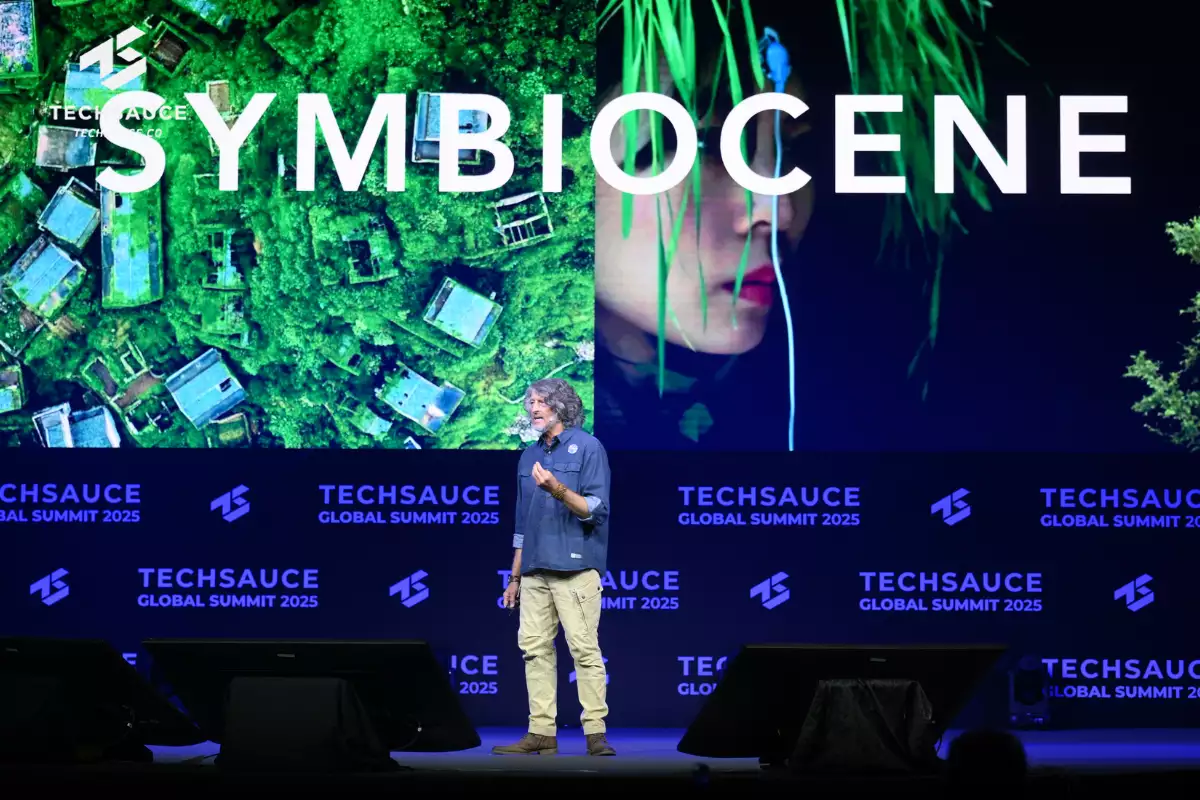
From the Anthropocene to the Symbiocene: Defining a New Human Era
We currently live in what scientists call the Anthropocene—the epoch where human activity has been the dominant influence on the climate and environment. Marc defines it more starkly as "a term that signifies how destructive humanity has been to our only home." We have been obsessed with competition, resource extraction, and hierarchy.
But the solution is not to go backward. It is to leap forward into a new era called the Symbiocene, a concept from Glenn Albrecht's book “Earth Emotions.”
Symbiosis, or mutual interdependence, is the heart of this new era. Marc defines it as “the fastest and most powerful form of evolutionary innovation in the world”—faster than Quantum, AI, or any biotechnology, because it is “cooperation and collaboration.”
This is not a new idea but a fundamental law of nature that has driven life for over 3.8 billion years. As the renowned biologist Lynn Margulis explained in her books “The Symbiotic Planet” and “Microcosmos,” life on Earth did not begin and evolve through competition, but through the symbiotic cooperation of microorganisms.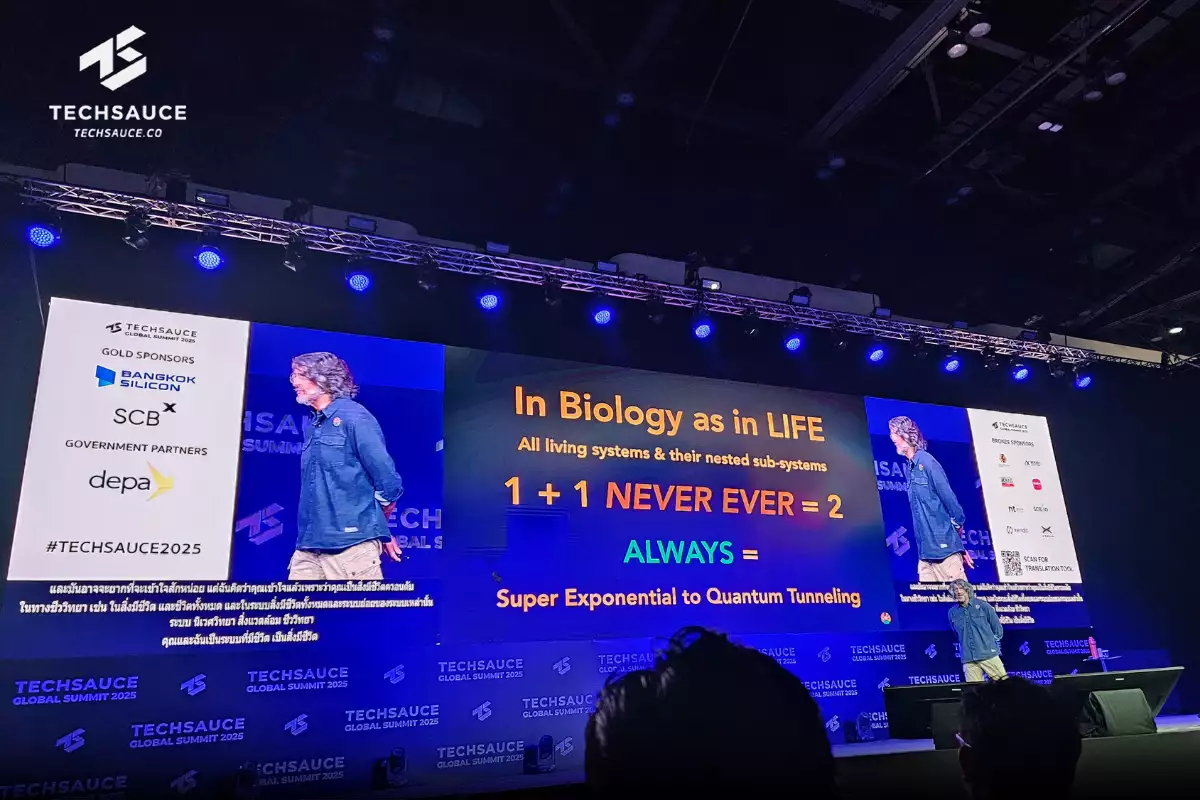
The Quantum Truth: Why 1+1 Never Equals 2 in the Living World
“In biology, as in life, and in all living systems... 1+1 never, ever, ever... equals 2.”
Marc repeated this sentence emphatically to shatter our familiar linear logic. He explained that the result of synergy in living organisms is super-exponential, approaching a phenomenon known as Quantum Tunneling.
- We are quantum beings: Our brains contain 86 billion neurons firing signals at 431 km/h—faster than an F1 race car. A fetus in the womb has 70 trillion cells and 14 quadrillion mitochondria (the bacteria that generate energy), all working together in quantum-level complexity.
- Nature is the quantum master: Michio Kaku, the father of quantum string theory, explains that “photosynthesis in plants is a quantum process that no conventional computer can replicate.” This is why we are developing quantum computers—to try and understand what plants have been doing for billions of years. He stressed, "Plants and natural organisms are far more advanced quantum computers than we are."
- Cooperation creates something greater: Federico Faggin, the creator of the first microprocessor, adds that “competition is a closed door,” whereas “cooperation is what allows for growth.” He poses a thought-provoking question: “How does ‘Survival of the Fittest’ explain the 50 trillion cells cooperating in my body?” He concludes that Emergent Properties, where the whole creates something far greater than the sum of its parts, exist only in quantum physics and are driven by cooperation, not competition.
The Regenerative Blueprint in Action
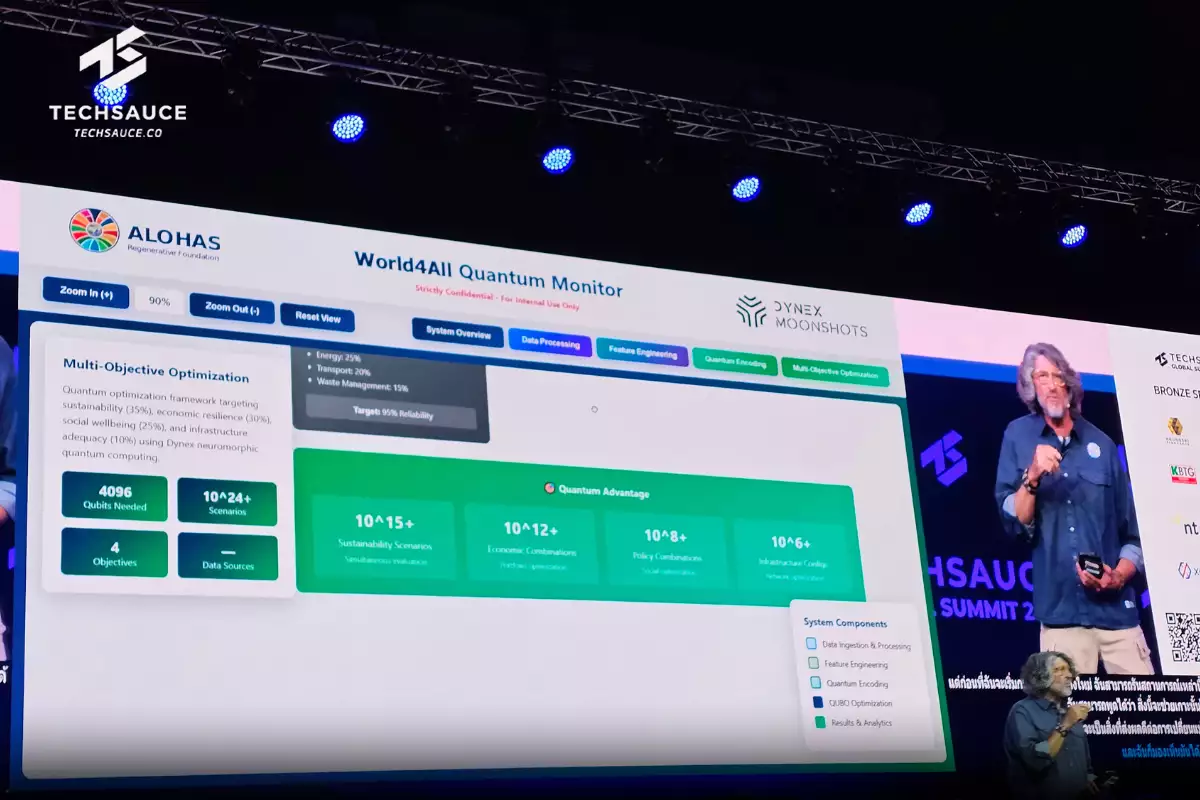
With the theory established, how do we put it into practice? Marc showcased the Dynex Moonshots project as a tangible example.
This project uses a Quantum Engine to create a Digital Twin of the island of Hvar in Croatia to plan for its regenerative development. Its capabilities include:
- Processing 6.8 billion different scenarios per second.
- Analyzing 72 quadrillion complex configurations simultaneously.
- Consider every variable—from wind, water, and energy to agriculture, infrastructure, and birth rates—to find the optimal solution before a single brick is laid.
This is the power of Regenerative Development, defined as “creating the conditions for life to thrive and flourish in the midst of change.” And it's poised to become the next massive economic wave, with staggering market values:
- Regenerative Built Environment: $280 Trillion
- Regenerative Agriculture: $780 Trillion
Lessons from 32 Collapsed Civilizations: The Fatal Flaw of “Hierarchy”
To underscore why our current model is failing, Marc shared findings from the "Handy Study," which analyzed 32 ancient civilizations that have collapsed.
- The Cause: Most civilizations collapsed due to environmental and ecological crises.
- The Common Thread: All 32 civilizations used the exact same structure: a Hierarchy Model, with a king or emperor at the top and farmers, slaves, and laborers at the bottom.
- The Fatal Flaw: The laborers and slaves forming the base of the pyramid were not indigenous people. They were brought from other lands to build a civilization in which they would never have a sense of ownership or participation—no buy-in. This lack of a symbiotic connection was the critical vulnerability that led to their downfall.
“Think about Dubai. Where do all the peasants, slaves, laborers, and farmers come from that are in Dubai? We don't call them that, we call them hospitality workers, taxi drivers, construction workers, and farmers. But they come from the Philippines, they come from Pakistan, they come from Asia. They're not indigenous.”
The Final Evolution: From Ego to Eco and Seva
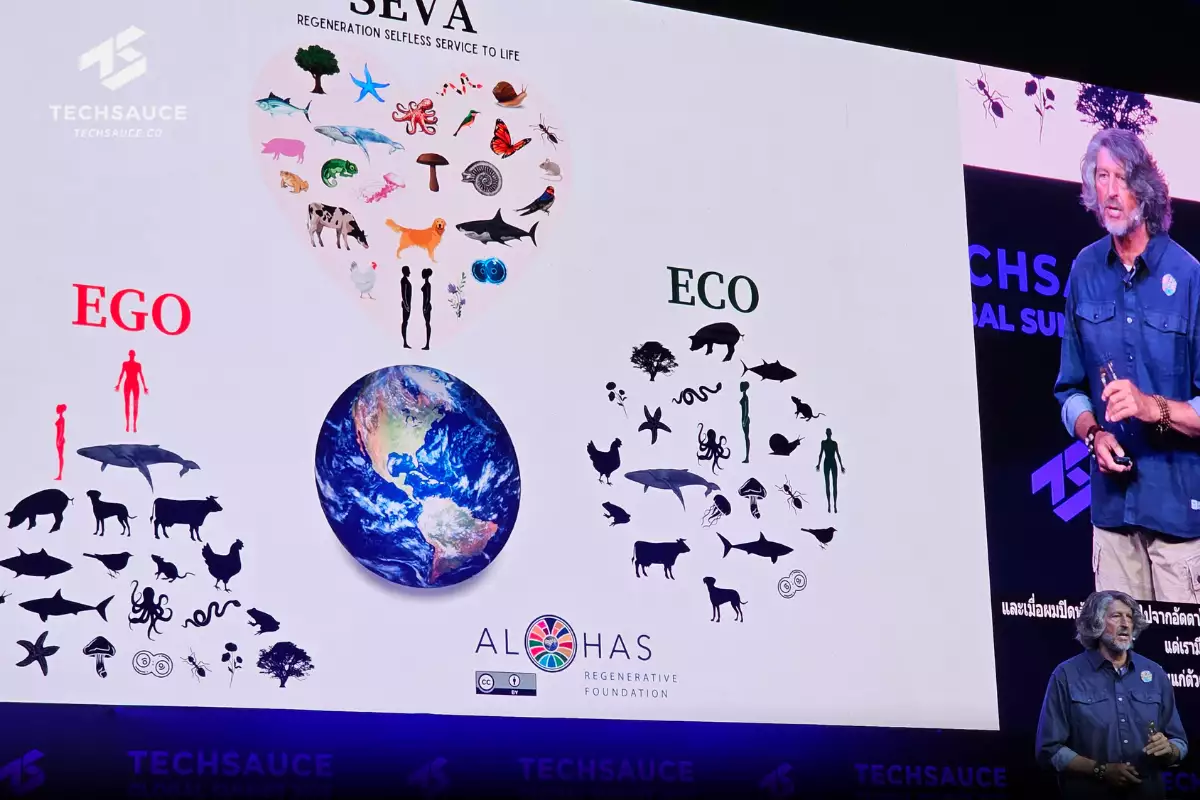
Marc's conclusion is a three-stage journey for evolving the human paradigm:
- From Ego (self-centered): The hierarchical model where humans are above all else.
- To Eco (ecology-centered): Where we realize we are part of an ecosystem and work in concert with all things.
- To Seva (service to all): A state of selfless service dedicated to benefiting all life without expectation of return.
“It is not the strongest of the species that survives, nor the most intelligent, but the one most responsive to change.”
Finally, Marc introduced his RegenAsia initiative to help drive this transformation across Asia and invited attendees to interact with his AI Avatar on his website to explore the worlds of Symbiosis and Regeneration limitlessly.
What Marc Buckley described on stage was more than just a technological trend; it was a call to re-examine the most fundamental laws of life. It was a declaration that humanity's only path forward in the 21st century is not fiercer competition, but an unprecedented level of cooperation to build a future that doesn't just “survive,” but truly “flourishes and regenerates.”
Based on the session: “Quantum Leap to Regenerative Futures: The Dawn of Symbiosis,” by Marc Buckley at the Techsauce Global Summit 2025.
ลงทะเบียนเข้าสู่ระบบ เพื่ออ่านบทความฟรีไม่จำกัด


Japan handles disasters exceptionally well because it has a 'culture of resilience' embedded in daily life. Research by Professor Miho Mazereeuw and the book Design Before Disaster...
 0
0

The SME Sustainability Playbook: Turning Cost to Competitive Edge
For SMEs, sustainability can feel like an expensive burden. This article, based on insights from Techsauce Global Summit, UOB, and Panpuri, provides a practical playbook. Move beyo...
0
Regeneration from Two Generations: What We Need to Transform
At Techsauce Global Summit 2025, Dr. Sirikul Laukaikul and Sirikanes Sakulyong explored how regeneration—beyond sustainability—can guide branding, design, and technology to heal ec...
0