
A Vision That Demands Action: A Conversation with Tanit Chearavanont About Makro PRO and Two Awards of the Year
Some parts, I admit, were difficult challenges for me. But I have to thank the team for believing in me when others said it couldn’t be done.
When Techsauce asked Tanit Chearavanont, Group Chief Wholesale Business Officer of CP AXTRA Public Company Limited, how he felt about receiving two awards, his first answer did not begin with numbers or his own success. He went back to the day he decided to shut down Makroclick and move everything onto Makro PRO—the day an external consultant told the team to their faces that this approach could not be done and that he might fail.
At Techsauce Awards 2026, Tanit received The Sauciest Tech Visionary of the Year award, while Makro PRO received The Sauciest Tech Scaleup award. Backstage at the awards, Techsauce sat down for an in-depth interview with Tanit, joined by Tirayu Songvetkasem to discuss the vision, decisions and working process behind the four-year journey that brought a traditional wholesale business to this point.
The conversation showed how difficult it is to separate the award for the leader from the award for the platform. Whenever Tanit spoke about vision, he returned to the team. Whenever Thirayu spoke about scaling up, he returned to the leader’s direction and decisions.
Two Awards on the Same Journey
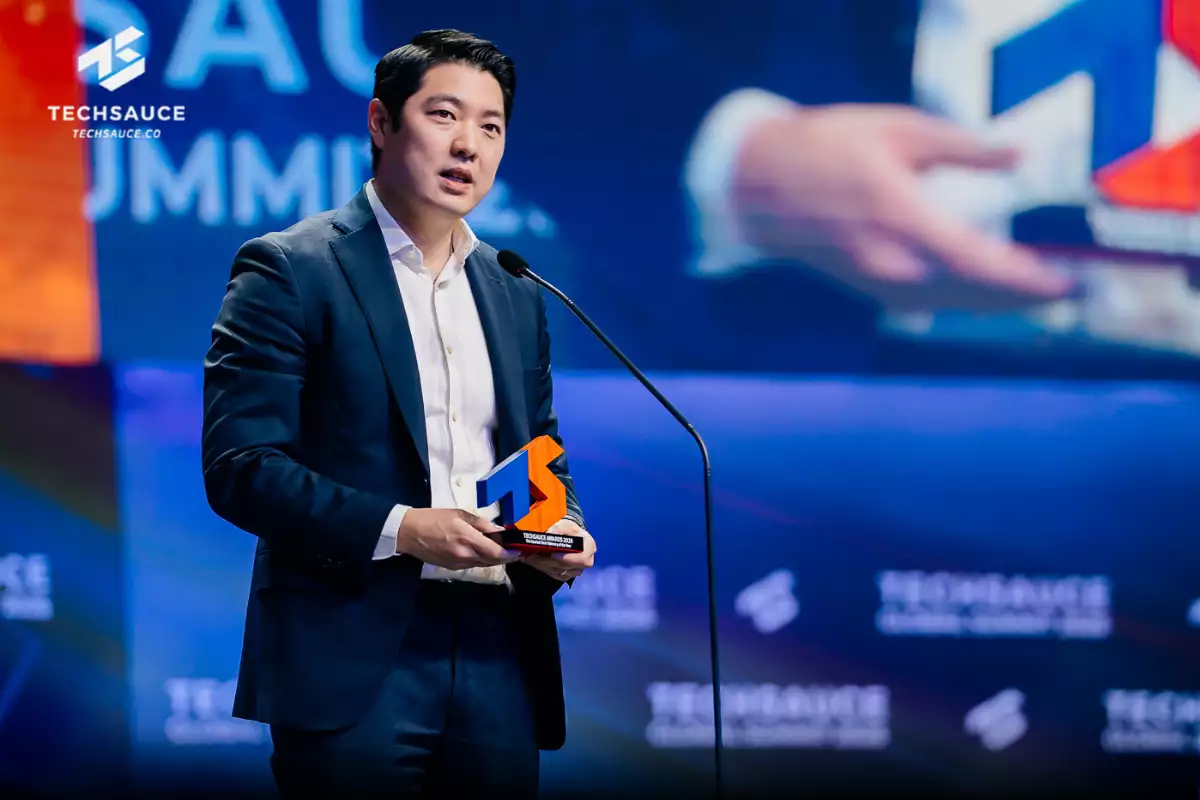
Tanit received The Sauciest Tech Visionary of the Year award for his role in leading Makro’s transformation from a traditional wholesale business into Retail Tech. The Sauciest Tech Scaleup award went to Makro PRO, a platform launched in 2022 that has grown into a Thai e-commerce platform and become Thailand’s No. 1 e-commerce platform in first-party (1P) sales, according to Euromonitor.
Over the same period, e-commerce’s share of Makro’s sales rose from 3% to more than 30%. The figures show just how far the business has come.
Although the growth has been impressive enough to look like a proven formula, what both men told Techsauce was that there was never a point along the way when the team could simply keep using the same approach and continue moving forward indefinitely.
The Day They Had to Choose How to Move Forward
One of the most important decisions came when Tanit chose to shut down Makroclick and move everything onto Makro PRO. An external consultant had told the team to their faces that no one could migrate systems in this way and that Tanit might fail.
What Tanit saw at the time was that if CP AXTRA wanted to build a large e-commerce platform, maintaining two applications with two separate engineering teams would constrain the business’s ability to scale. He therefore believed that Makroclick and Makro PRO had to be consolidated into a single application, before SmartOne, another B2B system, was later integrated as well.
The system consolidation enabled Makro PRO to support approximately 250 to 260 million baht in daily sales. But the journey was not smooth. Tanit admitted that he was concerned about whether the Order Management System, along with each part of the back-end infrastructure, would be able to handle the transaction volume.
The team pressed ahead with a clear understanding that keeping teams and systems separate would not take the organization far enough, even though no one at the time could guarantee that every part of the plan would work perfectly.
One Transformation Was Not Enough

The decision to shut down Makroclick and consolidate everything into Makro PRO was only the beginning. Once the new system went live, the team found that organizational transformation did not end with a single change. Every time the business grew, the systems and ways of working they had just created could become too small for the next goal.
Tirayu Songvetkasem, Chief Digital Officer – CP AXTRA Public Company Limited, had worked on the front line alongside Tanit from the beginning. From his perspective, Makro PRO’s transformation was a process of “Continuous Disruption,” because every time sales increased, the previous way of working began to struggle with the new scale.
When daily sales rose from 12 million baht at the start to 30 million baht, the team had to change how it worked. When sales reached 70 million baht, systems that had once worked had to be adjusted again. And as the platform continued to grow to several times its previous scale, the organization had to change with it—across systems, processes and team management.
For this team, speed therefore covers the entire process: making decisions quickly, identifying problems quickly, admitting mistakes quickly, solving problems and reorganizing the team fast enough. Tanit distinguishes speed from the number of hours worked. He does not expect people to work a 996 schedule—from 9 a.m. to 9 p.m., 6 days a week—but he does expect results that reflect the same level of speed.
Behind that speed is the discipline not to remain attached to the old way of doing things. Scaling a business from tens of millions to hundreds of millions, and from hundreds of millions to the next goal, cannot be achieved using the same operating system throughout the journey.
The 4-3-3 Formula of a Leader Willing to Decide
Tanit summarizes his approach to decision-making with the “4-3-3 strategy.” If he has to make 10 decisions, he accepts that 4 may turn out very well, 3 may deliver ordinary results that can be improved, and the remaining 3 may be mistakes.
Tanit explains that a decision that turns out to be wrong is not always a bad decision. It is a cost of learning that an organization must be willing to accept, because waiting until every piece of information is complete may cause the team to lose the opportunity to learn from the real market.
However, his decisiveness does not mean that a leader should think alone. Tanit says that he always consults the people around him and his team, because several minds can examine a problem from more angles than one mind alone.
A leader’s job is to listen enough, then have the courage to decide when the time comes.
This model gives the word “visionary” a highly practical meaning. Vision does not end with seeing the future. It must come with the ability to make decisions while information remains incomplete and to lead the team in learning from the outcomes that actually follow.
From Buying Technology to Building It Together
Problems with the order management system, in-store picking and certain off-the-shelf software systems led the team to realize that CP AXTRA could not rely solely on purchasing technology from external providers. Tanit therefore began building critical systems in-house, from order management and loyalty systems to the Pricing Engine.
At the same time, building everything in-house would require too many resources. The answer was therefore a Co-Creation model that transformed the relationship with technology companies from buyer and seller into partners jointly developing technology.
This approach led to the development of technology suited to the Thai context and the filing of 4 patent applications. They cover a personalized search-ranking system, an encoding system for Thai-language processing, a product-search system that combines keyword matching with semantic matching, and a voice-ordering system in which multiple AI models work together.
Co-Creation therefore meets two needs: CP AXTRA gains access to knowledge from global partners, while the Thai team retains a role in designing the technology and owns the intellectual property created in Thailand.
The Next Goal: Becoming an ASEAN Retail Tech Leader

After establishing a base in Thailand, Tanit’s goal is to make CP AXTRA a Retail Tech leader in ASEAN. The next stage is to expand into international markets, starting with Southeast Asia.
Tanit believes Thailand still lacks a Thai-built e-commerce platform capable of competing at the regional level. He therefore wants to see Makro PRO grow to stand in the same market as global platforms and to make the team that has built it together since day one proud of what they have achieved.
When asked when he wanted to reach that point, Tanit answered: within two years. He wants Makro PRO’s sales to match the transaction value of Thailand’s second-ranked platform. This goal still lies in a future that has yet to arrive, and he knows that the decisions of one person alone cannot take the organization there.
Tanit cannot be the only one holding the sword. It has to be a team. Everyone has to believe for us to get there.
The story of Makro PRO therefore does not define the word “visionary” solely through the ability to see the future. It defines it through what happens afterward: making decisions when the full answers are not yet available, building new systems when the old ones can no longer support the business, and bringing a large number of people together in the same direction.
And that may be where this year’s two awards converge. Vision only becomes meaningful when there is a team that turns it into reality. Scale, meanwhile, cannot happen without a direction clear enough for everyone to believe in and move forward together.
ลงทะเบียนเข้าสู่ระบบ เพื่ออ่านบทความฟรีไม่จำกัด

When AI Chooses for Your Customer: Accenture Song on the New Rules of CX
Accenture Song's Tuomas Peltoniemi on how AI agents are taking over customer decisions, and the five lessons brands need before the buyer stops being human....
 0
0

20 Years of Lessons from DeeMoney's CEO Technology Moves Information, but Trust Is What Moves Money
DeeMoney co-founder and CEO Aswin Phlaphongphanich unpacks the unspoken facts of global payments at Techsauce Global Summit 2026: there is no global transfer network, payment firms...
1

When Finance Must Shift from Recovery to Driving the Future
From the session “Olympics of Finance: Synergy for the New Frontier of Growth” at Techsauce Global Summit 2026, held on August 26, 2026, at the Main Stadium....
0