
Food Safety Needs a Data Layer Before It Needs AI
As Thailand accelerates its FoodTech ambitions, the conversation is increasingly dominated by AI. However, food safety modernization is not first an AI challenge — it is a data integrity challenge. Before predictive models and intelligent automation can deliver value, the industry must build a trustworthy operational data layer grounded in measurement, verification, and defensible compliance. In food safety, infrastructure comes before intelligence.
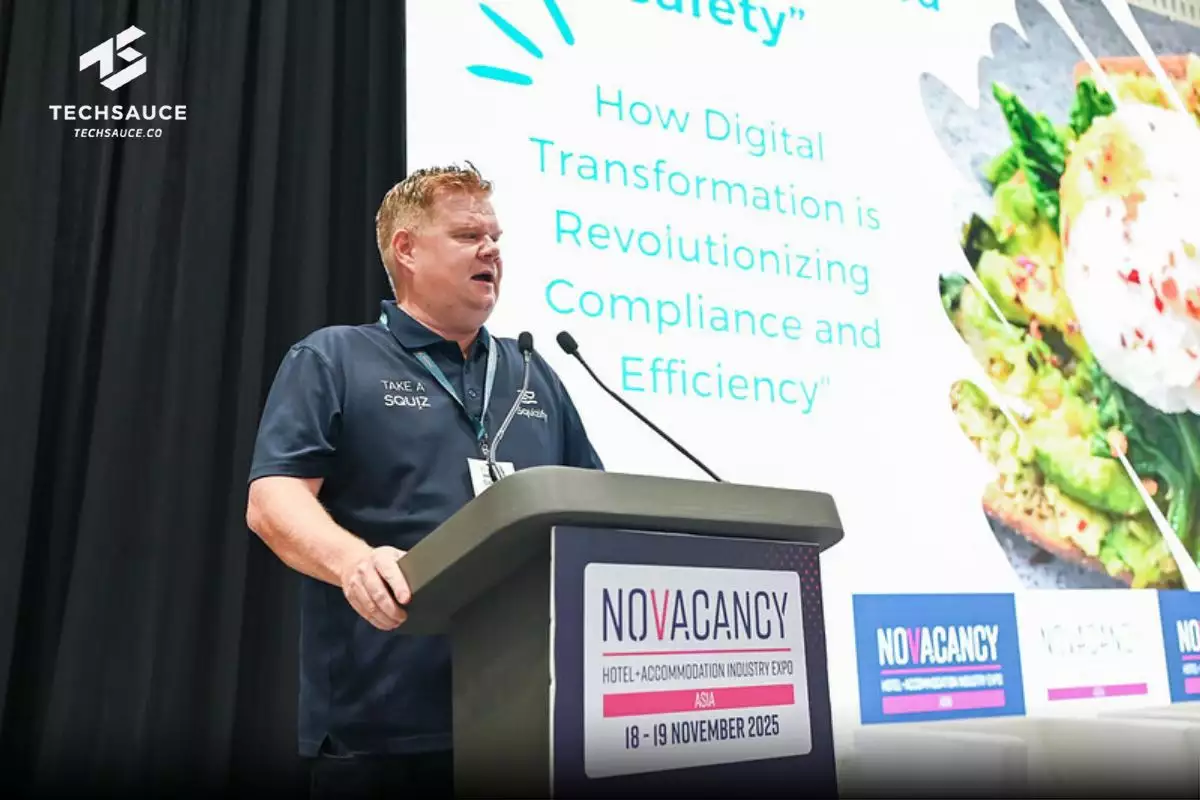 Food safety as innovation infrastructure
Thailand’s FoodTech momentum is often framed as a natural evolution: from “Kitchen of the World” to an innovation launchpad where deep tech meets real industrial scale.
But food safety sits beneath that ambition.
Traceability systems rely on time-stamped events. Shelf-life optimization depends on environmental stability and cold chain performance. Export confidence depends on defensible compliance records. Sustainability reporting increasingly depends on measurable operational data.
If temperature, handling, and critical control data are incomplete or unverifiable, every higher layer of FoodTech innovation becomes structurally weaker.
Food safety, in this sense, is not a regulatory overhead. It is the operating data backbone of modern food systems.
The World Health Organization estimates unsafe food causes 600 million cases of foodborne disease and 420,000 deaths each year. When safety fails, the impact is human first — and then operational, legal, and brand-defining.
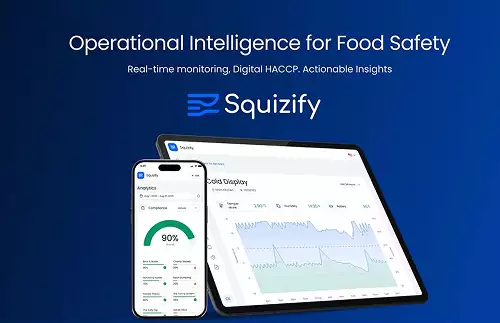
Yet in many real kitchens and food operations, the daily safety control loop still runs on manual workflows. Staff take spot checks, write logs, and file paper or spreadsheet evidence for audits. Under labor pressure, this model becomes structurally fragile.
A compliance system that depends on perfect manual execution during peak hours is a system designed to drift — quietly — into unverifiable records.
This is the shift leaders need to recognize: food safety is becoming a data infrastructure problem before it is an AI problem.
AI is powerful, but it cannot compensate for missing or unreliable operational data,” says Daniel McDouall, CEO and tech founder of Squizify. “In food safety, intelligence is only as strong as the measurement beneath it. Before we talk about predictive systems, we need to ensure the underlying data is continuous, time-stamped, and defensible. Otherwise, we are building automation on top of uncertainty.
And the path to better outcomes does not begin with predictive models. It begins with instrumentation, automation, and proof.
Why food safety is now an industry data problem
Food safety management systems such as HACCP are built around discipline: identify hazards, monitor critical control points, apply corrective actions when limits are breached, verify the system works, and maintain records.
These are not administrative rituals. They are the mechanism by which an organization proves its controlled risk.
If records are incomplete, unverifiable, or maintained after the fact, the organization is not only operationally exposed — it may also be unable to demonstrate defensible compliance when incidents occur.
The cold chain adds further complexity. Refrigeration is not simply a cost center; it is a safety boundary condition. It is also increasingly linked to sustainability outcomes.
The FAO has highlighted that food cold chains contribute around 4% of global greenhouse gas emissions when accounting for cold-chain technologies and food loss due to insufficient refrigeration. Performance failures are therefore not only safety risks — they are waste and emissions risks.
In this context, food safety becomes an operational data challenge: continuous measurement, timestamp integrity, and defensible traceability.
The AI conversation is real — but it is downstream of trustworthy data
AI in food safety is advancing rapidly. Applications range from detecting spoilage and fraud to building predictive safeguards by combining sensors, measurement tools, and models. But major reviews also flag practical barriers such as data gaps and trust in model outputs.
The most practical near-term AI opportunities for hospitality and food operations cluster around three areas:
Anomaly detection
Detecting temperature excursions, drift, and unusual patterns early. Cold chain research emphasizes multi-dimensional sensor streams, signal noise, and real-time constraints — reinforcing why monitoring quality matters.
Predictive maintenance
Anticipating refrigeration and compressor degradation before failures cascade. Data-driven approaches rely explicitly on historical, time-series data for early fault detection.
Supply-chain batch risk analytics
Flagging potentially problematic lots earlier by connecting supplier, transaction, and equipment datasets for anomaly detection and prediction.
But these applications share a non-negotiable prerequisite: a clean, time-stamped, trustworthy operational dataset.
Predictive maintenance research show that models are limited when data lacks explicit timestamps, because temporal patterns matter in early fault detection. Many model classes also require large amounts of labeled data — or carefully structured semi-supervised approaches — before becoming reliable in production environments.
The strategic sequence is simple:
First build a data layer reliable enough to audit.Then build analytics reliable enough to act on.
A practical illustration: the compliance–labor conflict at scale
As refrigeration assets and compliance checkpoints increase, the labor required to maintain accurate temperature logs scales quickly. In large hospitality and food operations, manual safety logging can consume significant staff time each day — time that competes directly with service delivery.
More critically, under sustained labor pressure, manual systems become vulnerable to process drift. Logs may be completed after the fact or based on assumption rather than real-time measurement. The result is not necessarily intentional non-compliance, but a fragile system that creates the illusion of control without defensible proof.
Leaders in digital food safety, including Squizify, have consistently emphasized that the issue is not discipline — it is system design. When compliance depends on perfect manual execution during peak operations, integrity risk becomes structural rather than accidental.
At scale, the challenge is not whether teams care about safety. It is whether the system makes accurate documentation sustainable.
A practical framework: Instrument, Automate, Prove, Improve
To modernize food safety as innovation infrastructure — without turning it into a transformation science project — operators and builders can apply a structured sequence:
Instrument
Identify the highest-risk, highest-frequency control points — often refrigeration and cold chain first — and ensure the environment can be measured continuously.
Automate
Reduce reliance on perfect manual logging by automating capture where feasible. This lowers labour burden and reduces record integrity risk.
Prove
Design records to be verifiable. Monitoring, corrective actions, verification, and record-keeping are explicit HACCP expectations.
Improve
Once the dataset is trustworthy, use it for operational learning — reducing recurring excursions, strengthening maintenance strategy, and laying the foundation for future predictive analytics.
Building a bridge between food safety and innovation, the goal is not to digitize paperwork. It is to build a measurable, defensible operating system for trust.
In the race toward AI-driven FoodTech, the most competitive organizations in Thailand, — and the most competitive nations — will not be those that adopt intelligence fastest. They will be those that first build infrastructure strong enough to support
ลงทะเบียนเข้าสู่ระบบ เพื่ออ่านบทความฟรีไม่จำกัด

When AI Chooses for Your Customer: Accenture Song on the New Rules of CX
Accenture Song's Tuomas Peltoniemi on how AI agents are taking over customer decisions, and the five lessons brands need before the buyer stops being human....
 0
0

20 Years of Lessons from DeeMoney's CEO Technology Moves Information, but Trust Is What Moves Money
DeeMoney co-founder and CEO Aswin Phlaphongphanich unpacks the unspoken facts of global payments at Techsauce Global Summit 2026: there is no global transfer network, payment firms...
1

Some parts, I admit, were difficult challenges for me. But I have to thank the team for believing in me when others said it couldn’t be done....
0