

The ROI of AI Should Be Measured by Work Completed, Not Just Time Saved

If an organization could finish its entire annual plan in two months, what would it do with the capacity it had just created?
That was the question Sid Sharma, Head of Go to Market for ASEAN at OpenAI, posed to business leaders at Techsauce Global Summit 2026 during his session, ROI of Intelligence: Capturing Growth Beyond the Productivity Trap.
The question takes AI beyond the familiar measures of hours saved and costs reduced. As AI becomes capable of handling longer and more complex assignments, its greater return may come from what an organization can now attempt: advancing projects that were previously stuck, exploring ideas that never had enough resources, and bringing long-term plans forward.
From better answers to completed work
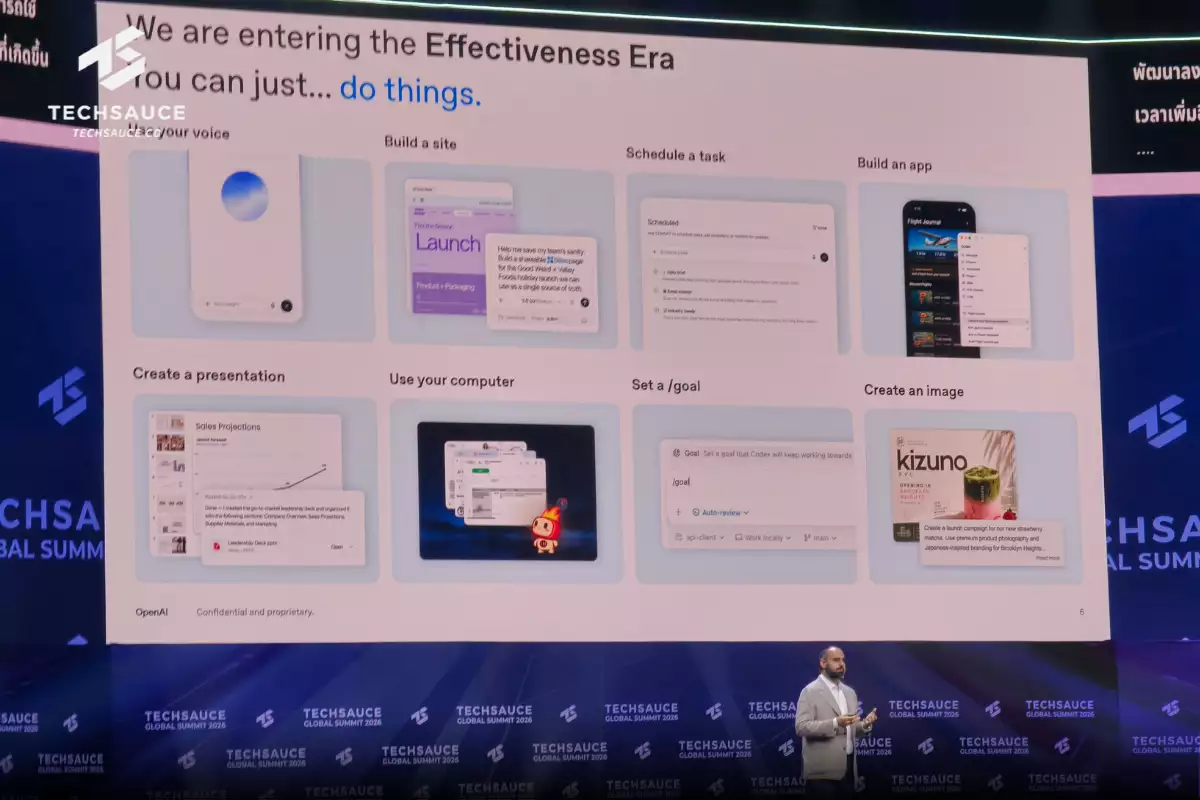
Sid described the evolution of AI through a shift in how its value is measured. In the early days of ChatGPT, users asked a question and received an answer. Models then became better at reasoning and gained access to files, applications, and systems, giving them more context. The next step was agents that could take action, followed by teams of agents capable of coordinating with one another.
User expectations evolved with those capabilities. A few years ago, an AI-generated travel itinerary could feel impressive. Today, people increasingly expect AI to book the tickets, add the flights to their calendars, and manage the related steps until the task is complete.
The unit of value is therefore moving from an answer to an outcome. Organizations are looking beyond how well a model responds and asking how many assigned tasks it completes, whether the quality holds up, and whether people can depend on the result in their daily work.
Sid called this the “Effectiveness Era.” The central question is how much more capable AI can make people across an organization, rather than how much more of the same work each person can be expected to produce.
When AI becomes a personal operating system
Sid illustrated the change with his own workflow. His work spans email, Slack, hundreds of Google Docs, and multiple AI agents that continuously bring him information. He used Codex and ChatGPT Work to build a personal operating system that acts like a chief of staff.
Every hour, the system reviews new information, prioritizes it, decides which tasks it can advance with the context already available, and prepares the issues that still require Sid’s attention. When he opens his computer, he no longer needs to begin by checking every channel. He starts with a view that helps him decide where to direct his energy.
He also described assigning a long-horizon task that ran for two days while retaining the context needed to produce an outcome. This kind of capability allows AI to work across multiple stages, including research, analysis, and production, instead of being limited to isolated question-and-answer exchanges.
Using AI as a personal assistant is still only the starting point. The larger business impact emerges when these capabilities become part of the organization’s shared workflows.
The 8.3x gap between frontier and typical firms
OpenAI described one group in its analysis as “frontier firms,” defined as the top 10% of enterprises by output tokens per employee. The metric does not capture ROI in full, but it provides one signal of how much real work organizations are delegating to AI.
According to the data Sid presented, the gap between frontier and typical firms expanded from 2.6x to 8.3x within five months. The difference comes from how AI is embedded in work, not simply whether employees have access to a licensed tool.
Frontier firms share three characteristics. They provide broad access to AI, their leaders actively support and use the tools themselves, and they treat AI as an organizational ecosystem. They do not hand employees a chatbot and immediately expect one person to do the work of ten. Instead, they build an environment where people can work more creatively and where AI can carry tasks further.
Agentic use is also spreading beyond engineering. OpenAI’s data showed growth of more than 100x in legal teams and more than 40x across sales, marketing, and recruiting within the enterprises studied.
These figures suggest that enterprise AI is moving from a specialist tool for developers to infrastructure for many forms of knowledge work. That expansion, however, depends on aligned access controls, organizational data, and governance.
A shared intelligence layer across the company
Sid presented the idea of an “intelligence layer” across the organization. In this model, ChatGPT Work supports employees, Codex supports technical users, APIs allow developers to embed AI in products, agents carry work across teams and tools, and controls give administrators governance and oversight.
The core of this layer is shared context and organizational memory, rather than the number of tools deployed. When agents can access the right information, understand permissions, and pass work between systems, AI can help manage an end-to-end process.
In the NVIDIA example shown during the session, one employee said that manual number-crunching had previously consumed around 40% of their time. That process now runs automatically twice a week. Sea Group, meanwhile, has deployed ChatGPT Work across the organization and uses Codex as part of an integrated agentic development workflow, moving beyond passive code completion.
When teams begin delivering products earlier than planned, companies have to reconsider their roadmaps. If something scheduled for six to ten months from now can be built today, the leadership question changes. The priority is no longer limited to accelerating the existing plan. Leaders must decide what the organization is ready to create with its new capacity.
In Thailand, Sid announced that Agoda is using Codex with almost every developer, covering software development, cybersecurity, CI/CD processes for testing and deploying code, and broader improvements to software delivery. He also said Thailand ranks among the world’s top 20 markets for weekly ChatGPT and Codex usage, while Codex usage in the country has grown 350x in recent months.
These are OpenAI figures presented during the session, but they point to an important shift in Thailand. AI use is expanding beyond learning, translation, and creative experimentation toward building real systems and products.
Measure useful intelligence per dollar
As AI takes on multi-step work, measuring cost only through token prices or selecting the cheapest model can produce an incomplete picture. A smaller model may cost less per token, but if it requires more turns, more human guidance, and extensive correction before the task is finished, the total cost can be higher than using a more capable model that completes the work in one pass.
Sid proposed a different unit of measurement: “useful intelligence per dollar.” This means evaluating three things together: how many tasks are completed successfully, whether the results meet the required quality and reliability standards, and whether the value created grows as the organization continues to use the system.
What is the useful intelligence I’m getting per dollar?
This framework moves organizations beyond the productivity trap of counting only the time saved. Faster work creates growth when the organization uses its added capacity to launch new projects, improve products, or address problems that had remained unresolved because of limited people and time.
Sid outlined four steps for leaders: provide broad AI access, redesign workflows instead of merely repairing old ones, lead through hands-on use at the top, and ensure that the benefits reach every part of the workforce, including frontline employees.
Ultimately, measuring the ROI of AI requires organizations to look beyond lower costs. If a full year of planned work can be completed in two months, do leaders have the imagination, organizational readiness, and governance needed to turn the time they have gained into growth?
Reference: ROI of Intelligence: Capturing Growth Beyond the Productivity Trap, presented by Sid Sharma, Head of Go to Market for ASEAN at OpenAI, at Techsauce Global Summit 2026 on August 26, 2026.
ลงทะเบียนเข้าสู่ระบบ เพื่ออ่านบทความฟรีไม่จำกัด

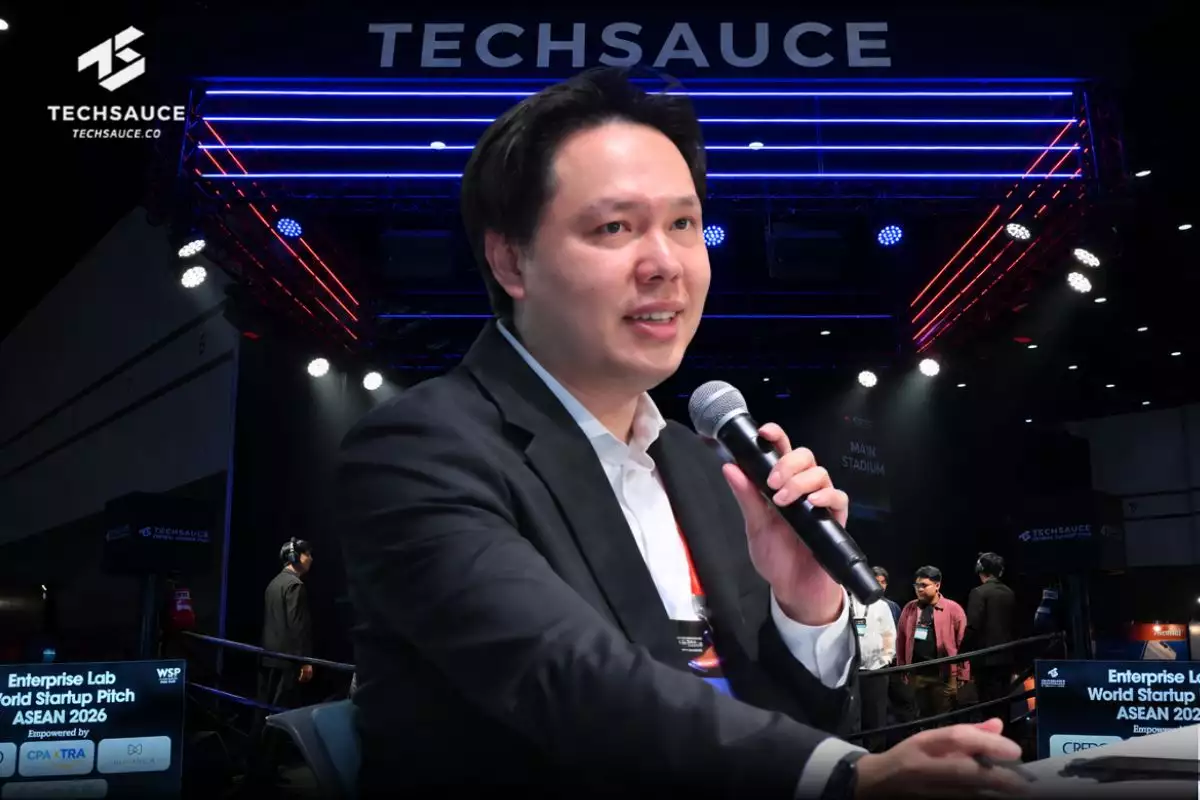
Following the Enterprise Lab World Student Pitch ASEAN Edition at Techsauce Global Summit 2026, Techsauce spoke with Tirayu Songvetkasem, Chief Digital Officer of CP AXTRA. As an E...
 0
0

When AI Chooses for Your Customer: Accenture Song on the New Rules of CX
Accenture Song's Tuomas Peltoniemi on how AI agents are taking over customer decisions, and the five lessons brands need before the buyer stops being human....
0

20 Years of Lessons from DeeMoney's CEO Technology Moves Information, but Trust Is What Moves Money
DeeMoney co-founder and CEO Aswin Phlaphongphanich unpacks the unspoken facts of global payments at Techsauce Global Summit 2026: there is no global transfer network, payment firms...
1

Thank you for this interesting post on calculating the ROI of AI. I especially love the emphasis on evaluating completed work rather than just time saved; it's a refreshing viewpoint that many people ignore. As an IT professional, I frequently face difficulties in accurately assessing fnaf 2 performance.