
Thailand's Economy Isn't About How Much You Earn—It's About Turning Cost Into Potential

Applications for BOI (Board of Investment) promotion submitted in the first half of 2026 reached 1.5 trillion baht, or around 45 billion USD. That's a 40% increase over the previous period and a new record. The numbers confirm that investment is flowing toward Thailand. The real question is: what will the country do with it?
Dr. Santitarn Sathirathai, Vice Minister of Finance, addressed this in his session "New Horizons for Thailand's Economy: Connecting Technology to Growth" at Techsauce Global Summit 2026. Rather than opening with technology itself, he began with the bigger picture of Thailand's economic growth—arguing that technology and innovation aren't confined to industry, but represent a genuinely new growth engine for the economy, a vision he shares with Dr. Ekniti Nitithanprapas, Deputy Prime Minister and Minister of Finance. The core message of the session: success shouldn't be measured by how much investment pours in, but by how much real, lasting potential it creates for the country.
When adding more people and resources is no longer the answer
For years, Thailand's growth model relied on adding more inputs to the system of more labor, more resources. But that model is becoming harder to sustain, largely due to an aging population and a shrinking workforce. Dr. Santitarn pointed to research suggesting that this demographic decline alone could shave roughly one percentage point off Thailand's GDP growth every year.
If Thailand can no longer grow simply by adding more people and resources, the only path forward is productivity, a word that carries more weight than it might seem. Productivity isn't just about doing the same things more efficiently; it's about finding new methods to do existing work, and creating new things the world actually needs. And this challenge doesn't exist in isolation, it's unfolding against a backdrop of major global shifts happening at the same time.
A fracturing world and Thailand's role as a "Trusted Connector"
The global economy is fragmenting, and geopolitics is reshaping supply chains in real time. Companies worldwide are rethinking where to invest, where to manufacture, and who they can trust. For an open economy like Thailand, that shift brings real risk—but it also brings real opportunity.
Thailand occupies an unusual position: strong economic ties across many regions, proximity to major fast-growing economies, a stable manufacturing base, and a long track record of attracting international investment. Dr. Santitarn proposed that Thailand lean into this position and become a Trusted Connector in an increasingly fractured world.
That opportunity is already taking shape—reflected in the 1.5 trillion baht in investment applications filed in the first half of the year. What matters even more than the total figure is where that capital is going: high-tech AI and electronics, the green economy, and robotics. As this new economy takes hold, two questions follow: what can Thailand contribute to it, and what can it, in turn, contribute to Thailand?
The JPPCC and the search for new areas of investment
The first question comes down to making Thailand an attractive, high-value place to invest—one that's genuinely integrated into global supply chains. The government's mechanism for this is the Joint Public-Private Consultative Committee (JPPCC), which works directly with the private sector as one of the country's key economic pillars. One of its central goals is to define concretely how Thailand can build capabilities that make it indispensable to the global economy. Dr. Santitarn outlined three focus areas.
AI Economy: Thailand doesn't need to build frontier models—it needs to win at the application layer
The first area is the AI economy, where Thailand has already invested in foundational infrastructure: data centers, photonics, and power electronics, with government support behind it. But Dr. Santitarn raised a more pointed question.
Thailand isn't positioned to compete with global leaders in building frontier foundation models. The massive AI models that require enormous capital and computing power to train. But Thailand does have a real shot at leading in the application layer: taking existing models and turning them into practical solutions for real industries. The real opportunity lies in the startups that can build AI solutions in the sectors where Thailand already has deep expertise in healthcare, tourism, agriculture, logistics, and finance. The goal is to build a homegrown ecosystem where companies can grow domestically and eventually scale onto the world stage.
Longevity Economy: Turning an aging population into an advantage
The second area is the longevity economy, essentially flipping the aging-population challenge into an opportunity. An aging society creates new markets and demand for new services, and Thailand is already recognized globally for its healthcare and wellness sector.
The challenge is that much of the value in this space such as medical devices, pharmaceuticals, functional food ingredients are currently created elsewhere. Thailand's task is to capture more of that value domestically, by combining its strengths in public healthcare with capabilities in biotechnology, agriculture, and research, to develop its own products and innovations around aging, and eventually export them to the world.
Green economy: renewable energy as more than just carbon reduction
The third area is the green economy, where the government has made decarbonization and sustainable energy a national goal. This isn't just an environmental target, it's a potential engine for new industry, from clean energy technology to the broader supply chains that support it.
What ties all three areas together, as Dr. Santitarn emphasized repeatedly, a single underlying question: not how much investment Thailand can attract, but how Thailand creates its own value, where Thai companies fit into that value chain, and how the country builds capabilities that can't easily be replicated elsewhere.
Technology shouldn't become Thailand's economy on its own
Having addressed what Thailand can offer the new economy, the second equally important question is what the new economy can offer back to Thailand. The key point is that technology alone can't be the center of Thailand's economic strategy. Having basic AI infrastructure that's competitive on a global level isn't enough on its own.
If AI doesn't translate into real improvements for Thai industry and agriculture, it falls short. If the green economy doesn't meaningfully strengthen the broader economy, that's not enough either. And if Thai suppliers—especially SMEs—can't find a way into these emerging supply chains, then building new industries in isolation won't be enough to move the country forward.
Redefining Success: Not by the Money, But by Thai Capability
That bridge begins with redefining how we measure investment success. Under Dr. Ekniti's leadership, the Ministry of Finance isn't just counting how much money flows into the country—it's focused on how much of that new capital converts into domestic capability, and how much value it generates within Thailand over time.
Dr. Santitarn pointed to an example: projects approved by the BOI in the first half of this year are expected to create more than 82,000 jobs for Thai workers, and to generate over 10 billion USD annually in domestic procurement of raw materials and components which is roughly 42% of total production inputs. The Ministry of Finance's goal is to push that figure even further.
On the human capital side, the goal is to make sure investment translates into new skills and clearer pathways to better jobs. That's why programs like BOI SkillBridge which links new investment directly to workforce development, including upskilling and reskilling programs, matter so much. So far, 35 projects have been approved under the initiative, targeting the development of around 66,000 people, spanning AI, cloud computing, and cybersecurity through semiconductors, robotics, biotechnology, and medical technology. The end goal isn't simply to bring the new economy into Thailand, it's to use that new economy to transform the Thai economy as a whole.
New Horizons: The Same Challenge Awaits Thailand on the World Stage Later This Year
Later this year, Thailand will host delegates from around the world for the IMF–World Bank Annual Meetings in Bangkok, under the theme Thailand has chosen: "New Horizons: Empowering People, Building Resilience." Dr. Santitarn sees this theme as a near-perfect reflection of the challenge every country is facing right now—a world moving forward with unprecedented technological possibility, yet also becoming more fragmented, more volatile, and more uncertain at the same time.
The answer to that kind of world isn't to cut yourself off from it. Real resilience doesn't come from isolation, it comes from building strong domestic capability alongside connections the rest of the world can trust. And no one can build that future alone, which is exactly why gatherings like Techsauce matter: they're spaces that connect technology with policy, connect capital with ideas, and connect world-class innovation with local entrepreneurs.
Dr. Santitarn closed his address by emphasizing that Thailand's task isn't simply to ride the next technology wave—it's to turn capital into capability, turn new industries into opportunities for the broader economy, and turn Thailand's role as a trusted connector in a fracturing world into a genuine new source of growth for the country.
The mechanisms discussed are already in motion: the Joint Public-Private Consultative Committee (JPPCC), working with the private sector to build a new engine for investment, and BOI SkillBridge, which has already approved 35 projects. Meanwhile, the IMF–World Bank Annual Meetings will take place in Bangkok later this year.
Source: Session on ‘New Horizons for Thailand’s Economy: Connecting Technology to Growth’ by Dr. Santitarn Sathirathai, Vice Minister of Finance at Techsauce Global Summit 2026
ลงทะเบียนเข้าสู่ระบบ เพื่ออ่านบทความฟรีไม่จำกัด

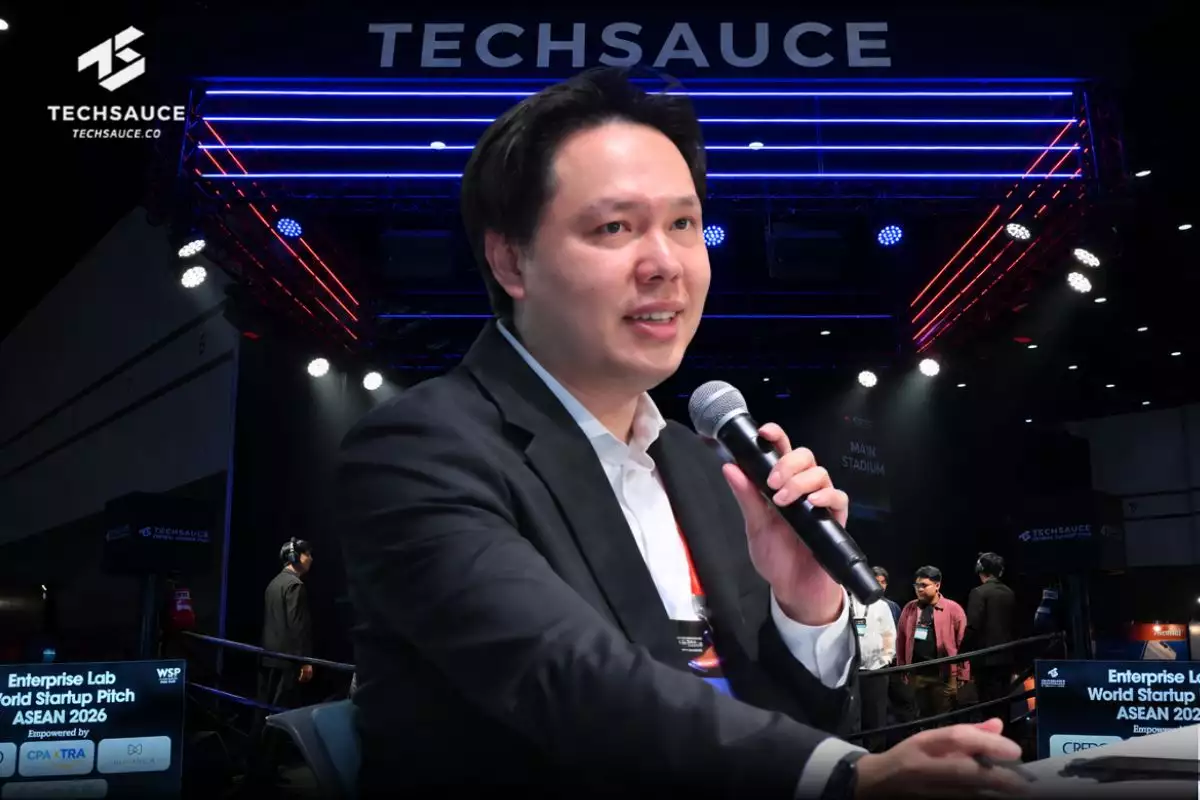
Following the Enterprise Lab World Student Pitch ASEAN Edition at Techsauce Global Summit 2026, Techsauce spoke with Tirayu Songvetkasem, Chief Digital Officer of CP AXTRA. As an E...
 0
0

When AI Chooses for Your Customer: Accenture Song on the New Rules of CX
Accenture Song's Tuomas Peltoniemi on how AI agents are taking over customer decisions, and the five lessons brands need before the buyer stops being human....
0

20 Years of Lessons from DeeMoney's CEO Technology Moves Information, but Trust Is What Moves Money
DeeMoney co-founder and CEO Aswin Phlaphongphanich unpacks the unspoken facts of global payments at Techsauce Global Summit 2026: there is no global transfer network, payment firms...
1