
Rethinking Retail: A Conversation with Tirayu Songvetkasem on AI, Young Talent, and the Future of the Retail Workforce
We want to see young people who are passionate about Thai retail, look closely at the business, and show us how they would develop it further.
Following the Enterprise Lab World Student Pitch ASEAN Edition at Techsauce Global Summit 2026, Techsauce spoke with Tirayu Songvetkasem, Chief Digital Officer of CP AXTRA. As an Enterprise Lab co-host and judge, he evaluated students’ ideas for addressing CP AXTRA’s business challenges with technology, from supply chain management to customer experience.
Tirayu was impressed by the depth with which young participants explored the retail business and Makro PRO, a Thai e-commerce platform ranked No. 1 in Thailand for first-party (1P) sales. They identified opportunities to propose approaches that could support its further development.
The interview covers why Enterprise Lab matters to CP AXTRA, the role of digital solutions and AI in retail, and the talent that will help shape the industry’s future.
It also shows how closely technology, people, and business problems are connected. AI may accelerate change in retail, but creating results with it requires a deep understanding of the business and ownership of the problem from beginning to end.
Enterprise Lab Brings Real Business Challenges to Young Talent
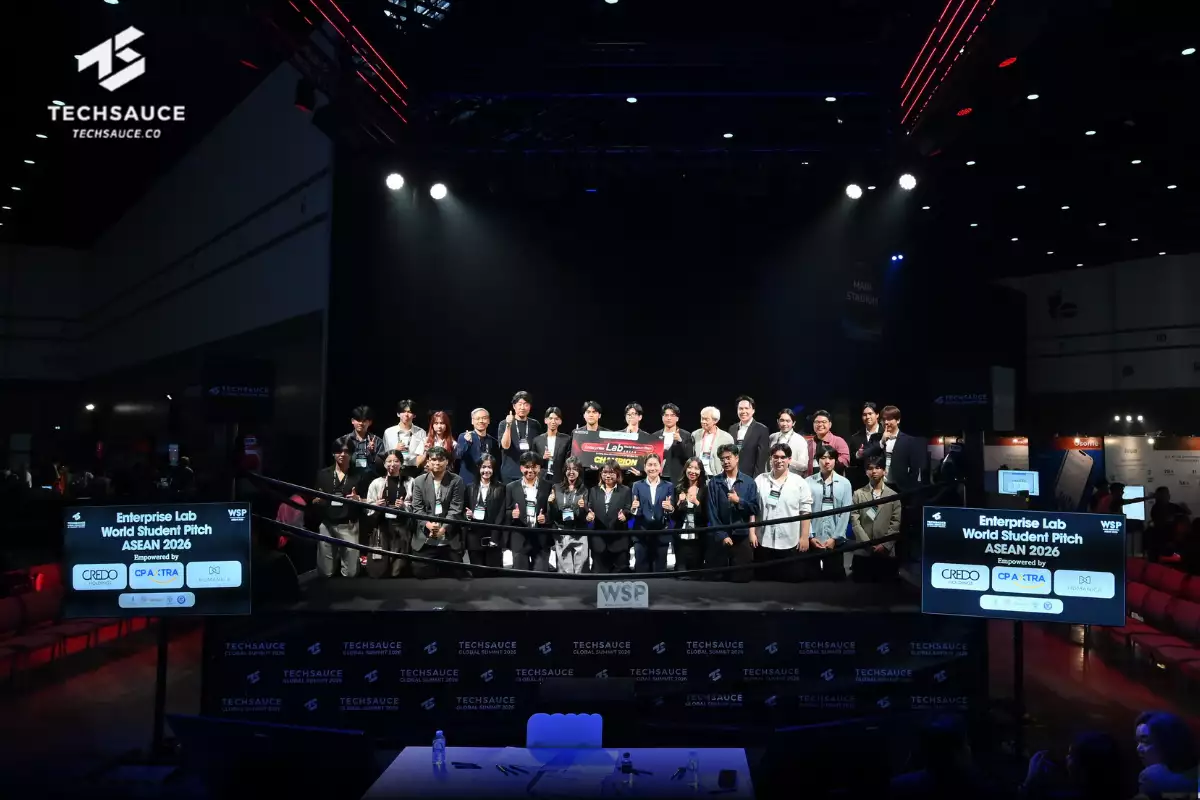
The Enterprise Lab World Student Pitch ASEAN Edition invited students aged 18 to 25 to propose ideas that address real business challenges. The final round took place on the Tech Showcase Stage at Techsauce Global Summit 2026.
The competition featured three challenges designed to invite ideas for business growth in different areas. One was the Retail and AI Challenge by CP AXTRA, which asked students to develop AI concepts for retail and wholesale businesses. The scope covered customer experience, smarter merchandise management, demand forecasting, supply chain efficiency, and new services for business customers.
CP AXTRA joined as a co-host in line with its strategy to develop technology for its own use, including AI and intellectual property developed in-house. In parallel, the company is strengthening the capabilities of its AXTRA Tech team, equipping its people with the knowledge, creativity, and skills needed to apply technology to real business challenges. The company also aims to attract and create opportunities for young tech talent to join the organisation, building a stronger team and driving the development of technologies and innovations that effectively address real business needs.
The programme created a bridge between business challenges and young people’s perspectives, giving students space to build on data, technology, and new ways of thinking. It also enabled CP AXTRA to see the technologies and solutions that interest younger generations, how participants think, and the capabilities of talent preparing to enter the workforce. These insights can inform the company’s future technology-team development.
Tirayu said CP AXTRA looks for ideas grounded in a serious understanding of Thai retail and strengthened by fresh perspectives. The opportunities span store management, pricing, product assortment, individual products, and the Makro PRO experience.
AI Can Transform Retail When It Starts with Business Understanding
Retail requires accurate decisions at every stage, from choosing products to sell and setting prices to managing stock at the right level and making products easier for customers to find and order.
Digital solutions and AI can support many parts of this process, from supply chain planning and merchandise and inventory management to customer experience. Applying these technologies effectively, however, begins with understanding the business.
Tirayu stressed that people solving problems in the AI era need domain knowledge first. They can then identify where technology can help and step beyond established approaches to find an answer that fits the real problem.
Solving problems in the AI era requires a genuine understanding of the business and its domain knowledge, followed by applying technology to address the problem.
This principle makes AI more than a tool an organisation simply installs. A system that creates business value must be designed around the realities of day-to-day operations. Without understanding the process, AI may solve only part of a problem or produce answers that are difficult to put into practice.
For Tirayu, this period resembles the early days of the internet. AI capabilities are evolving rapidly, and something that can do only so much today may advance much further within a few months. Businesses therefore need to follow new possibilities and revisit existing challenges to see whether better solutions have emerged.
Young People See the Bigger Picture and Turn Information into Answers Quickly
Tirayu saw students’ ability to access information, see the bigger picture, process what they found quickly, and turn it into new proposals that they could present with confidence.
These capabilities matter in retail because business problems are often interconnected. Improving an experience on a platform may involve products, prices, stores, and delivery. Changing store-management processes can also affect employees, costs, and customer experience at the same time.
Seeing these connections is an important capability for today’s workforce. For CP AXTRA, that alone is not enough. People joining the organisation should also be passionate about the problem and take ownership of their work.
Tirayu explained that people should be ready to understand a process from beginning to end, without first limiting themselves to whether a problem is a technology issue. They can then develop a solution that works in practice. Someone responsible for only one component may build a system that performs well at a single point, while someone who understands the full process can see how the final outcome affects the business and its customers.
The Next Era of Retail Welcomes Talent from Every Discipline

Looking five years ahead, Tirayu expects retail to become more open to people from a wider range of disciplines. In the past, applicants may have assumed that a retail career required a degree specifically in business administration, IT, or logistics.
Today, CP AXTRA is looking for more people with analytical, engineering, logistics, and technical capabilities. Each discipline brings a distinct way of thinking, and this diversity helps the organisation examine the same problem from multiple perspectives.
Retail connects people’s needs with available products. From sellers on online platforms to people designing back-end systems, everyone plays the role of a merchant in a more modern form.
Engineering graduates may apply systems thinking to improve processes. Technology graduates may develop new platforms. People from marketing, accounting, and other disciplines can connect their specialist perspectives with retail challenges.
Tirayu sees retail as one of society’s foundations because it connects people with the products they need in everyday life. As the industry welcomes a broader range of thinkers, retail can become a field where people from many disciplines build new systems together.
Retail’s Future Starts with People Ready to Solve Real Problems
Enterprise Lab showcased more than the ideas submitted by each student team. It also showed how young people approach retail challenges, from using data and connecting related problems to identifying where technology can help.
As AI capabilities evolve rapidly, people will need to keep learning and updating their technical skills. More enduring is the ability to understand a business, identify the problems occurring in practice, and know where technology should be applied.
This helps explain why the future retail industry will be open to people from more diverse disciplines. Educational background alone will not define who can contribute. What matters is the ability to connect one’s knowledge with a business problem and work across functions to develop an answer that works in practice.
As AI accelerates changes in tools and methods, the industry may not always need the person who knows the newest technology best. It needs people who understand the problem they are solving and can turn technology into tangible outcomes for businesses and people.
Reference: Interview with Tirayu Songvetkasem following the Enterprise Lab World Student Pitch ASEAN Edition judging session at Techsauce Global Summit 2026
ลงทะเบียนเข้าสู่ระบบ เพื่ออ่านบทความฟรีไม่จำกัด


When AI Chooses for Your Customer: Accenture Song on the New Rules of CX
Accenture Song's Tuomas Peltoniemi on how AI agents are taking over customer decisions, and the five lessons brands need before the buyer stops being human....
 0

20 Years of Lessons from DeeMoney's CEO Technology Moves Information, but Trust Is What Moves Money
DeeMoney co-founder and CEO Aswin Phlaphongphanich unpacks the unspoken facts of global payments at Techsauce Global Summit 2026: there is no global transfer network, payment firms...
1
Some parts, I admit, were difficult challenges for me. But I have to thank the team for believing in me when others said it couldn’t be done....
0