The Synergy of Two Worlds: How AI + The Human Brain Can Become the Engine of the 21st Century
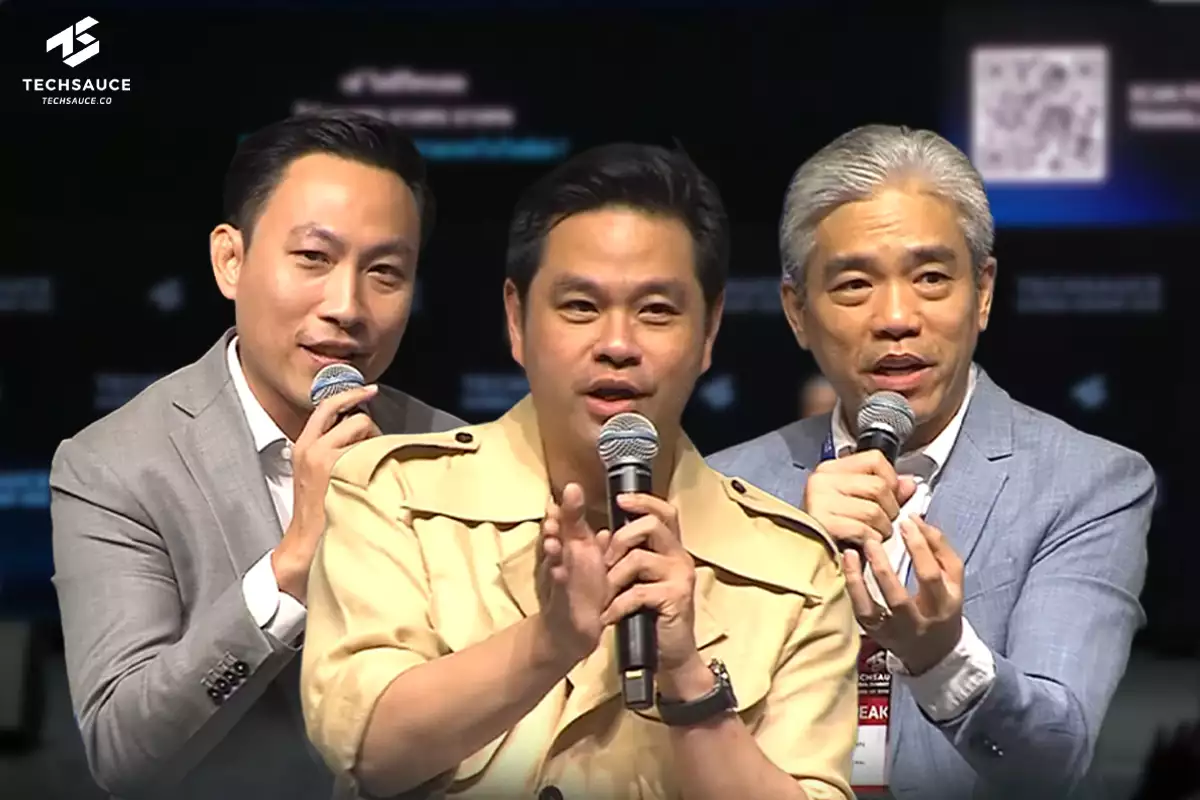
On the main stage at this year's Techsauce Global Summit 2025, one session brought together two different worlds—Tech and Non-Tech—for a compelling discussion. Dr. Wit Sittivaekin, Dr. Luis Kristhanin, and Peeranat Thoonsaengngam gathered to explore a familiar theme: “AI will change the world, but the world won't be changed by AI alone. It will change when AI joins forces with human Authentic Intelligence, and when people from Tech and Non-Tech backgrounds learn to speak the same language.”
This article breaks down the big picture of why this fusion is so critical and provides practical tools that you and your organization can implement immediately.
From Electricity to AI: When Technology Equals Technology + Imagination
Dr. Wit began by taking the audience back to the eras of electricity, radio, and the internet. He pointed out that world-changing technologies never succeed in isolation; they are always paired with the imagination and application of people who may not even be engineers.
- Electricity lit up cities because someone envisioned a power distribution system.
- Radio waves became a tool to prevent ships from colliding at sea.
The internet, which started with email, evolved into online shopping because marketers saw an opportunity.
He left the audience with a crucial point: AI today is no different. Without human interpretation and adaptation, it risks becoming just another lifeless technology.
The Three Eras of AI: From Seeing > Thinking > Creating
Mr. Peeranat simplified the evolution of AI into three distinct eras. He emphasized that the key for non-tech professionals is not to start by asking, "Which AI should I use?" but rather, "What is my pain point?" From there, you can identify which AI features can provide the solution.
- The Perception Era: Face-unlock cameras, license plate readers—AI that can “see” the world.
- The Cognition Era: Content recommendation systems, chatbots, LLMs—AI that can “think, analyze, and suggest options.”
- The Creation Era: Generative AI for creating text, images, audio, and video; AI Agents that can perform multi-step tasks autonomously (e.g., booking tickets, finding deals, sending emails).
Dr. Luis's Secret Formula for Organizations
With the technological perspective grounded in human needs, Dr. Luis shifted the focus to the organizational level. He redefined the “A” in AI to stand for Alignment and the “I” for Integration.
Alignment means getting everyone oriented in the same direction and speaking the same language, even if they come from different departments.
Integration is about weaving together the expertise of each department—from marketing's customer insights and sales' on-the-ground knowledge to HR's understanding of people, finance's grasp of constraints, and IT's systems expertise.
Dr. Luis shared an example from a Lego Serious Play workshop where executives built models of their ideas and placed them on a shared table. The meeting room, once filled with jargon, was transformed. As soon as a shared visual representation was created, everyone understood each other without lengthy debates. The technical-heavy meeting became a forum where everyone saw the same picture, no long explanations needed.
A Playbook for Non-Tech Professionals: A 30-60-90 Day Implementation Plan
Phase 1: 0–30 Days: Start with Pain Points
List 10 tasks that are time-consuming, repetitive, or rule-based (e.g., summarizing meetings, answering HR queries, sorting documents).
Select 2 tasks with measurable outcomes (e.g., hours saved, improved SLA, satisfaction scores).
Build a quick prototype (in 1–2 days) to give the team something tangible to see and interact with.
Phase 2: 31–60 Days: Stabilize and Secure
Establish team guidelines for data: what can be used, what can't, where it's stored, and who gives approval.
Implement a “Human-in-the-Loop” for critical processes (e.g., legal or financial tasks requiring human review).
Try “Reverse Mentoring,” pairing junior employees who can teach tech skills with senior leaders who can teach business acumen.
Phase 3: 61–90 Days: Scale and Measure Value
Create AI OKRs (Objectives and Key Results) that are directly linked to business outcomes (e.g., reduce case resolution time by 40%, increase NPS by 10 points).
Move from a Proof of Concept (POC) to a Pilot within one department, complete with a weekly monitoring dashboard.
Establish a cross-departmental “AI Guild” to share best prompts, bugs, obstacles, and lessons learned each month.
KPIs You Should Measure (Choose Only What's Necessary)
- Business Outcomes: SLA (Service-Level Agreement), response time, cost per transaction, conversion rate, NPS/CSAT (Net Promoter Score/Customer Satisfaction).
- Usage: Retention rate, percentage of automated cases vs. human escalations.
- Response Quality: Accuracy, correct citations, consistency.
- People and Culture: Time given back to employees (hrs/week), team satisfaction, proportion of value-added work.
Based on the session: Synergy of Technologists and Non-Tech People: A Real Key to the New 21st Century at Techsauce Global Summit 2025.
ลงทะเบียนเข้าสู่ระบบ เพื่ออ่านบทความฟรีไม่จำกัด

Following the Enterprise Lab World Student Pitch ASEAN Edition at Techsauce Global Summit 2026, Techsauce spoke with Tirayu Songvetkasem, Chief Digital Officer of CP AXTRA. As an E...
 0
0

When AI Chooses for Your Customer: Accenture Song on the New Rules of CX
Accenture Song's Tuomas Peltoniemi on how AI agents are taking over customer decisions, and the five lessons brands need before the buyer stops being human....
0

20 Years of Lessons from DeeMoney's CEO Technology Moves Information, but Trust Is What Moves Money
DeeMoney co-founder and CEO Aswin Phlaphongphanich unpacks the unspoken facts of global payments at Techsauce Global Summit 2026: there is no global transfer network, payment firms...
1