
GovWare CEO Richard Ireland on Which Principles Must Hold as AI Speeds Everything Up
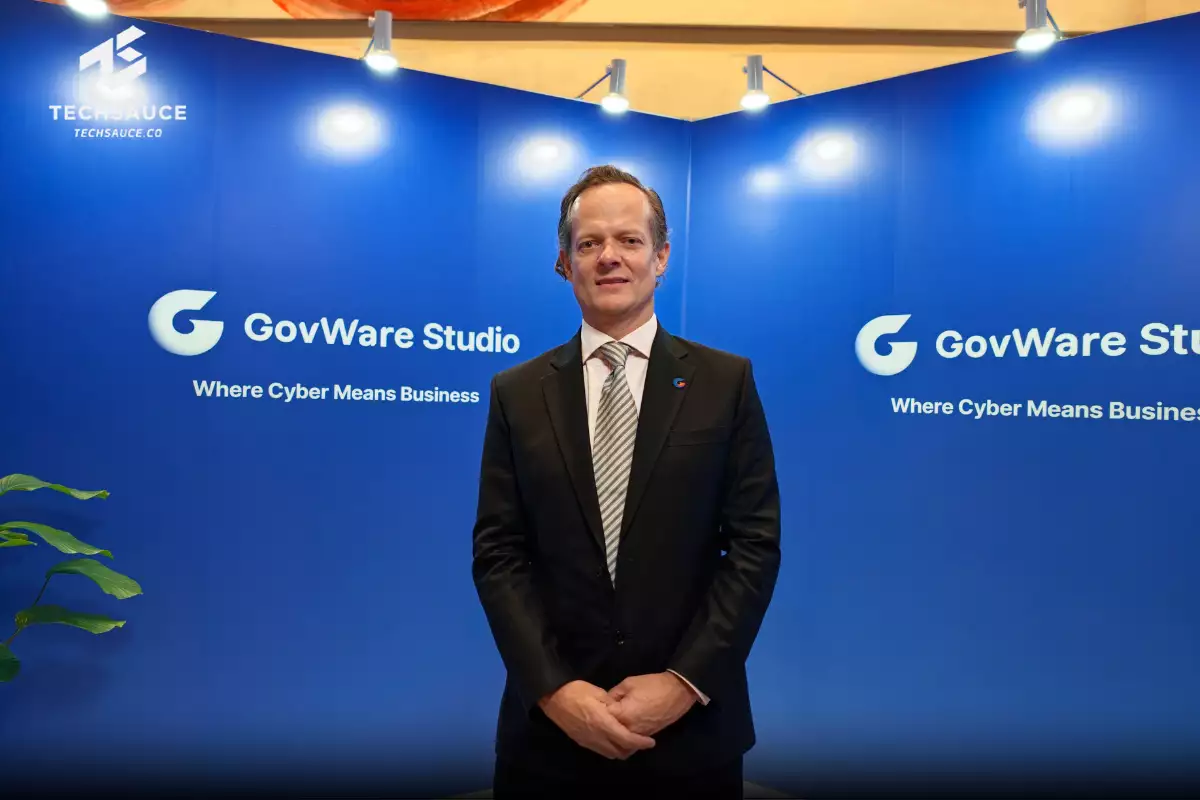
At first glance, the GovWare 2026 theme seems to pull in two directions at once. The first half, “Anchored in Unchanging Principles,” is about standing firm. The second half, “Cyber at Agentic Velocity,” is about keeping pace with agentic AI, meaning AI systems that can make decisions and take action on their own without waiting for step-by-step human instructions. That raises an obvious question: when everything is moving this fast, do the old principles still hold?
Techsauce spoke with Richard Ireland, Chief Executive Officer (CEO) of GovWare, during GovWare 2026 in Singapore, held as part of Singapore International Cyber Week (SICW) 2026. Ireland answered that question at the very start of the conversation: the pace has changed, but the principles should not. That answer became the thread running through everything else he discussed, from the topics dominating this year’s stage and decision-making in the age of agentic AI to the banks and hospitals that cannot afford to stop, and the cross-border scam problem that hits Thailand directly.
The Pace Has Changed, but Trust Stays Where It Is
Ireland acknowledged that the two ideas in the theme do create tension. The speed of AI, and what it means for how businesses and organizations are run, is enormous and very challenging. What the theme is trying to say, however, is that even as the pace changes, the principles must remain the same.
The first principle he named was trust. Organizations still need to work in a trusted environment, even at pace. The second was accountability. AI systems may move quickly, but that does not remove responsibility: the people who deploy them need to take accountability, and so do the users. Ireland also pointed to the boundaries around autonomy, noting that autonomy itself is not a new concept.
“The view of many people today is there shouldn’t be a compromise of principles just because AI happens at an enormous pace.”
That, he explained, is why GovWare chose this theme for 2026. Responsibility, accountability, agreed boundaries, and trust have not changed. What has changed is the pace, and Ireland acknowledged that this creates real challenges for organizations.
When asked whether trust had become the defining word of 2026, given how often it came up across sessions, Ireland said it was nothing new. What has become harder is working in a trusted environment while AI and autonomy keep accelerating. The principles themselves remain the same.
No More Pilots: The Question Now Is Deployment and Protection at Scale
Those unchanging principles, set against a faster pace, are clearly reflected in what the industry wanted to discuss this year. As the organizer, GovWare sees these shifts before anyone else through its Call for Papers and its conversations with exhibitors. Which topics surged compared with last year, and which ones quietly disappeared?
Ireland said GovWare received almost 500 submissions, which he described as enormous. Most striking was that more than 100 of them focused on AI alone. Beyond the numbers, the content itself had changed. People are no longer talking about AI pilots or AI in sandboxes. AI is real and already happening, so the questions have moved on to how to deploy it at scale and how to protect it at scale.
“So, no sandbox, no pilots. These are not the big discussions. It’s what’s happening at an organizational level, and how does the strategy change.”
In other words, the conversation is no longer about how to experiment with AI. It is about how AI is influencing the decisions organizations make, how it is increasing the threat to the organization, how AI can be used to counter that threat, and how threat actors are also using AI to penetrate further.
The same shift shows up in the agenda, which features more strategy sessions than last year. Ireland explained that many organizations have had to take a fresh look at parts of how they operate. The principles of trust, accountability, responsibility, and collaboration have not changed, but the pace, the autonomy, and the scale of rollout have all increased, putting more pressure on organizations.
When AI Closes the Gap Between Recommendation and Action
That pressure ties back to something Ireland has said before: cybersecurity took decades to evolve from a specialist technology concern into a whole-of-economy responsibility, and AI is now driving another transformation at far greater speed. So what does that speed actually look like in practice?
For Ireland, speed shows up in the distance between recommendation and action, and that is an enormous challenge. Traditionally, tools and systems could recommend a response, but a person still had to decide what to do and which response was right. Agentic systems combine those two steps. As a result, some decision-making is collapsing into machine-based decision-making, which Ireland described as a very new area.
“I think the main thing is speed shows the distance between recommendation and action. And that is an enormous challenge.”
The risk is that when systems or individuals are under pressure because of speed, mistakes can happen. The role of individuals is changing as a result. Instead of asking, “There has been an attack, what is my response?”, strategy needs to become more preemptive, rather than simply reacting once an attack has already happened.
“AI is helping that decision-making, but I think it’d be fair to say that those decision-making still goes through people and processes. And that hasn’t changed.”
If Money Stops Flowing, the Economy Stops Too
The consequences of a wrong decision are heaviest in sectors that cannot afford to stop. That is the thinking behind this year’s closed-door CII Forums for financial services and healthcare. The financial services forum featured a live incident scenario called “Keeping Money Moving,” while the healthcare forum included a scenario-driven discussion called “Keeping Care Running.” Why these two sectors, and what lessons can banks and hospitals in Thailand take away, even if they were not in the room?
Ireland explained that GovWare started out focusing on government agencies, but is now very much focused on Critical Information Infrastructure (CII), and both financial services and healthcare are CII. These two sectors were chosen because the consequences of disruption are so significant. If money stops flowing, people cannot use it for anything, from buying food to paying for education. The same is true for healthcare: an attack on healthcare systems or medical records has enormous consequences.
“If money stops flowing, the economy stops flowing.”
Beyond the scale of the consequences, critical infrastructure is also facing more attacks, so GovWare wants to give attendees highly specialized content about the sectors they serve. Taking healthcare as an example, Ireland noted that it is incredibly difficult for clinicians to make decisions without access to patients’ medical records. In highly digital environments like Singapore, digitized records allow better decision-making, but the consequences of a compromise are also very great.
Looking ahead, GovWare plans to run more CII sessions beyond financial services and healthcare, covering sectors such as transportation and energy, each with its own specific challenges. As Ireland put it, if there is no electricity, the impact is enormous.
Three Questions Every Thai Hospital Should Be Asking Now
For Thailand, Ireland suggested starting by thinking about the most important parts of the economy and what the consequences would be if they were disrupted. That is what GovWare aims to support by bringing like-minded people together to learn from each other, learn from different scenarios, and perhaps collaborate on responses.
On the hospital side, Ireland said that if he were running a Thai hospital, he would ask three questions. First, which services can never stop? Second, which people, systems, and outside providers do those services depend on? Third, who makes the decision when systems go down? In his view, these are the most important lessons, together with having provisions, backups, and strategies that can be put into action in a timely way.
“One of the things I’ve heard on the floor and in the content sessions: it is impossible to prevent 100% of attacks, so strategies around responsiveness are incredibly important.”
Scammers Thrive in the Gaps Between Organizations and Borders
If banks and hospitals are the systems that must never stop, scams are the threat quietly eroding trust in the financial system every day, and they have become one of the region’s biggest cyber challenges. The United Nations Office on Drugs and Crime (UNODC) estimates that scam losses across East and Southeast Asia, Australia, and New Zealand reached between US$88.3 billion and US$114.1 billion in 2025. In Thailand alone, people lost nearly 9 billion baht to online scams in the first half of 2026. This year’s agenda even included a session on using AI to attribute attacks to scam centers. What role can a platform like GovWare play in building the cross-border cooperation this problem requires?
Ireland said scams are tricky because they exploit the boundaries between organizations and countries. Many scams happen overseas, which makes them difficult for regulators to control. Suspicious activity also takes place on platforms that are interconnected through telecom providers, internet service providers (ISPs), and financial services. Banks hold records, but there needs to be a great deal of collaboration among banks, telcos, and ISPs to understand the full picture.
Because scams move between countries and between systems, they are hard to identify. Collecting information is difficult, which makes sharing information critical. AI can help identify where and how scams are happening, and which strategies need to evolve.
“GovWare is only a platform. We’re not a law enforcement body. But the key is about how do the various stakeholders share information and improve processes.”
As for Thailand’s figure of nearly 9 billion baht, Ireland said, “I’m sure it’s a lot more.” Sometimes victims do not know who to contact after being scammed. Information is held in different formats, some at banks and some at telcos. Organizations do not always have the capacity to share it, and when scams happen across borders, there is often no authority to report the incident to. As a result, scams are underreported, even though the impact is significant and often falls on the most vulnerable.
Ireland acknowledged that a conference alone will not solve all of these problems, but it can help establish relationships and information sharing, including a shared understanding of strategies and data points, along with the exchange of ideas and stories that can help prevent scams. When information is shared, policymakers can better understand where scams sit in the system and plan their defenses accordingly. The exhibition also features vendors offering anti-scam software, giving attendees a chance to see how these tools can help their organizations. With scams becoming a huge social issue, Ireland said he hopes a platform like GovWare can help.
AI Can’t Be Stopped, but We Can Be Prepared
Having discussed how AI both helps defend against threats and helps amplify them, the final question went beyond cybersecurity: should the world stop developing AI, or keep going while controlling it so that it helps people?
Ireland said it would be very hard to stop. Whether through automation or AI, the technology is already prevalent in society, and it is too late to stop it. He also thinks it will be quite hard for governments to regulate AI to the point of stopping it. His answer went back to the very first question of the interview: which principles should never be compromised? Trust, boundaries, and responsibility. Cyber safety, he said, can exist in the AI world.
“We don’t need to stop, we just need to be prepared.”
That, Ireland said, is the heart of GovWare’s theme this year, and the reason this community comes together to share stories and collaborate. For Ireland, the speed of AI may keep accelerating, but what organizations need to hold on to are the same principles they have always had.
References: Interview with Richard Ireland, CEO of GovWare, by Techsauce at GovWare 2026, part of Singapore International Cyber Week (SICW) 2026
ลงทะเบียนเข้าสู่ระบบ เพื่ออ่านบทความฟรีไม่จำกัด


Ajay Banga Says Aid Can Ease Poverty but Jobs Give People a Future
Ajay Banga explains why jobs, private capital and opportunity are central to the World Bank’s approach to poverty....
 0

It is really about the intersection of opportunity and risk. How do you invest at the right time while also managing the risk that some assets may lose value in the future?"...
0

WEF 2026: Suphajee Suthumpun Reveals New Thailand Global Trade Strategy
Minister Suphajee outlines Thailand's vision at WEF 2026, shifting from a tourism hub to a global strategic trade point. Discover the new focus on supply chain integration, digital...
0